AI in Healthcare: Diagnosis, Early Detection, and Personalized Medicine
AI in Healthcare: Diagnosis, Early Detection, and Personalized Medicine
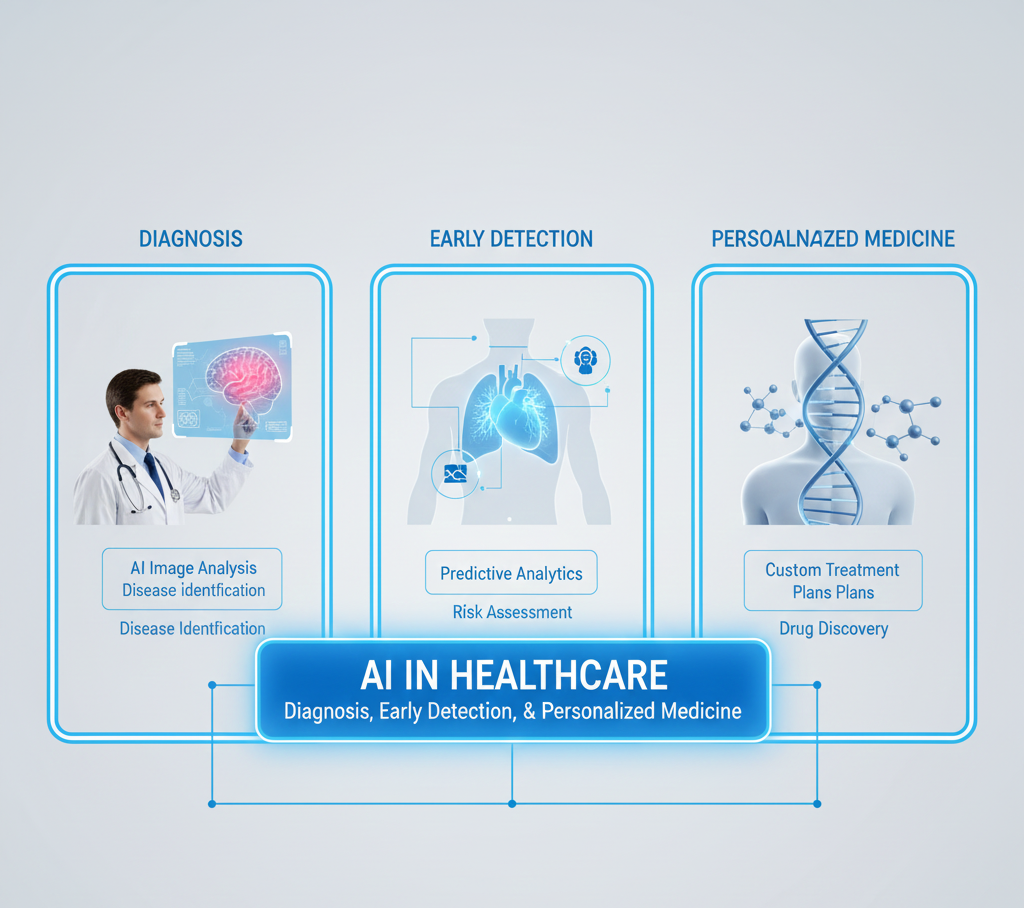
Artificial intelligence is transforming healthcare, offering unprecedented capabilities in diagnosis, early detection of diseases, and personalized treatment plans. By analyzing vast amounts of patient data, AI can uncover patterns invisible to the human eye, predict health risks, and assist medical professionals in making faster and more accurate decisions. From hospitals and clinics to research laboratories, AI is shaping the future of medicine, improving patient outcomes while streamlining workflows.
AI-Powered Diagnosis
One of the most significant applications of AI in healthcare is assisting with diagnosis. Machine learning algorithms can analyze medical images, such as X-rays, MRIs, and CT scans, to detect abnormalities with high accuracy. For example, AI systems can identify tumors, fractures, or signs of chronic conditions earlier than conventional methods. Beyond imaging, AI can process lab results, genetic information, and electronic health records to suggest potential diagnoses, helping clinicians confirm their findings and reduce diagnostic errors.
Early Detection of Diseases
Early detection is critical for conditions like cancer, cardiovascular disease, and neurological disorders. AI models analyze subtle patterns in imaging, lab results, and patient histories to flag potential health issues before symptoms appear. For instance, AI algorithms can detect minute changes in mammograms indicating early-stage breast cancer or subtle irregularities in retinal scans that suggest diabetic retinopathy. Early intervention can significantly improve treatment success rates and reduce long-term healthcare costs.
Personalized Medicine and Treatment Plans
AI enables personalized medicine by tailoring treatment to an individual’s unique genetic makeup, lifestyle, and medical history. Predictive models can forecast how patients will respond to specific medications, identify optimal drug combinations, and suggest adjustments to dosages. This approach minimizes trial-and-error in treatment, reduces adverse effects, and improves overall outcomes. AI also supports real-time monitoring, allowing clinicians to adjust therapies dynamically based on patient response.
AI in Drug Discovery and Research
Drug development is a time-consuming and expensive process. AI accelerates research by analyzing molecular structures, predicting drug interactions, and identifying promising compounds faster than traditional methods. Machine learning models can simulate clinical trials, prioritize candidates, and reduce the need for extensive trial-and-error testing. This innovation not only speeds up the discovery of life-saving drugs but also lowers development costs, making treatments more accessible.
Enhancing Patient Monitoring and Care
Wearable devices and IoT sensors generate continuous health data, including heart rate, blood pressure, and glucose levels. AI analyzes these streams in real time to detect anomalies, alert patients, or notify healthcare providers of potential emergencies. Remote monitoring supports chronic disease management, reduces hospital visits, and enables proactive interventions that prevent complications.
Predictive Analytics for Population Health
AI’s analytical capabilities extend to population health management. By aggregating data from multiple patients, healthcare systems can identify trends, predict outbreaks, and allocate resources efficiently. Predictive analytics help hospitals anticipate patient inflow, manage staffing, and prioritize high-risk patients, improving overall healthcare delivery.
Challenges and Ethical Considerations
Despite its potential, AI in healthcare faces challenges such as data privacy, algorithmic bias, and the need for rigorous validation. Patient data must be protected under strict regulations, and AI models must be trained on diverse datasets to ensure accuracy across populations. Transparency, explainability, and clinician oversight are essential to maintain trust and ethical standards in AI-assisted care.
The Future of AI in Healthcare
The future of healthcare will be increasingly collaborative, with AI supporting clinicians rather than replacing them. Integrated systems will combine diagnostics, treatment recommendations, remote monitoring, and predictive analytics to provide holistic, patient-centered care. Advances in AI explainability, multimodal learning, and real-time analytics will make healthcare more precise, efficient, and personalized.
AI in healthcare is revolutionizing the way diseases are diagnosed, detected, and treated. By combining machine intelligence with human expertise, medical professionals can deliver faster, more accurate, and individualized care—transforming patient outcomes and the overall healthcare landscape.
Offering capabilities that have never before been seen in the healthcare industry, artificial intelligence is altering the way that medical professionals diagnose illnesses, identify diseases early on, and create individualized treatment programs. Artificial intelligence is capable of uncovering patterns that are unseen to the human eye, predicting health concerns, and assisting medical personnel in making judgments that are both quicker and more accurate by evaluating huge volumes of patient data. Artificial intelligence is influencing the future of medicine in a variety of settings, including hospitals, clinics, and research labs. It is enhancing the results for patients while simultaneously simplifying procedures.
Diagnosis with the Assistance of Artificial Intelligence
Assisting in the process of making a diagnosis is one of the most important uses of artificial intelligence (AI) in the medical field. The process of detecting anomalies in medical pictures such as X-rays, magnetic resonance imaging (MRI), and computed tomography (CT) scans may be accomplished with a high degree of accuracy by using machine learning algorithms to evaluate the images. For instance, artificial intelligence (AI) systems are capable of detecting cancers, fractures, or indications of long-term illnesses at a point in time that is earlier than that of traditional approaches. In addition to the production of images, artificial intelligence has the capability to analyze laboratory data, genetic information, and electronic health records in order to provide possible diagnoses. This assists physicians in confirming their findings and decreasing the likelihood of diagnosing mistakes.
Before it’s too late, disease detection should begin.
It is of the utmost importance to identify illnesses such as cancer, cardiovascular disease, and neurological problems as early as possible. Subtle patterns in imaging, laboratory findings, and patient histories are examined by artificial intelligence models in order to identify possible health concerns prior to the onset of symptoms. Artificial intelligence systems, for example, are able to detect slight alterations in mammograms that may indicate the presence of breast cancer at an early stage or to identify small anomalies in retinal scans that are indicative of diabetic retinopathy. The success rates of therapy may be greatly improved and the expenditures of healthcare in the long run can be reduced with early intervention.
Individualized Medical Care and Therapeutic Strategies
Artificial intelligence makes it possible to customize medical therapy to a specific person’s medical history, lifestyle, and genetic composition via the practice of personalized medicine. Models that are predictive are able to foresee the way in which patients will react to certain prescriptions, determine the most effective combinations of drugs, and propose modifications to doses. By using this method, the amount of trial-and-error involved in therapy is reduced, the number of negative side effects that occur is decreased, and the overall results are enhanced. In addition, artificial intelligence (AI) provides assistance for real-time monitoring, which enables medical professionals to make dynamic changes to therapy depending on how patients are responding.
Research and Drug Discovery Utilizing Artificial Intelligence
The creation of new medications is a process that takes a long time and costs a lot of money. The use of artificial intelligence to expedite research is made possible by its ability to analyze chemical structures, forecast medication interactions, and find potential compounds at a pace that surpasses that of conventional approaches. The use of machine learning models may help to decrease the amount of time spent on trial-and-error testing, replicate clinical trials, and rank candidates. This advancement not only accelerates the discovery of medications that may save lives, but it also reduces the expenses associated with development, which in turn makes medicines more accessible to the general public.
Improving Patient Monitoring and Care
Continuous health data, such as glucose levels, blood pressure, and heart rate, is being generated by wearable devices and Internet of Things (IoT) sensors. To identify any unusual occurrences, notify patients, or alert healthcare providers to any possible emergencies, artificial intelligence (AI) performs a real-time analysis of these streams. Chronic illness management is facilitated by remote monitoring, which also decreases the number of trips to the hospital and allows for preemptive measures that avert the development of problems.
Population Health Predictive Analytics
Population health management is an area that artificial intelligence’s analytical skills may be used to. Healthcare systems are able to recognize patterns, anticipate the emergence of diseases, and distribute resources in a cost-effective manner by combining and analyzing information from a number of different individuals. Hospitals are able to improve the entire delivery of healthcare services by using predictive analytics to forecast patient influx, manage personnel, and prioritize patients who are at a higher risk.
Difficulties and Moral Concerns
Artificial intelligence in the healthcare industry has difficulties that include concerns about data privacy, algorithmic bias, and the need of rigorous validation, notwithstanding its promise. Artificial intelligence models must be trained on datasets that are varied in order to guarantee accuracy across different populations, and patient data must be safeguarded in accordance with stringent rules. The maintenance of trust and ethical norms in AI-assisted care is contingent upon the implementation of transparency, explainability, and clinical monitoring.
Artificial Intelligence and Its Prospects in the Medical Field
Artificial intelligence (AI) will be used to help physicians rather than to replace them. As a result, the future of healthcare will become more and more collaborative. By integrating diagnostics, suggestions for therapy, remote monitoring, and predictive analytics, integrated systems will be able to deliver comprehensive, patient-centered care. The medical industry will become more accurate, effective, and tailored to the individual as a result of improvements in artificial intelligence explainability, multimodal learning, and real-time analytics.
Artificial intelligence is transforming the medical industry by bringing about a new era in the diagnosis, detection, and treatment of illnesses. Medical practitioners are able to provide treatment that is quicker, more precise, and more personalized to the particular patient by integrating machine intelligence with human knowledge. As a result, the general landscape of healthcare and patient outcomes are both transformed.