The Shift From Manual Monitoring to AI-Based Industry Surveillance
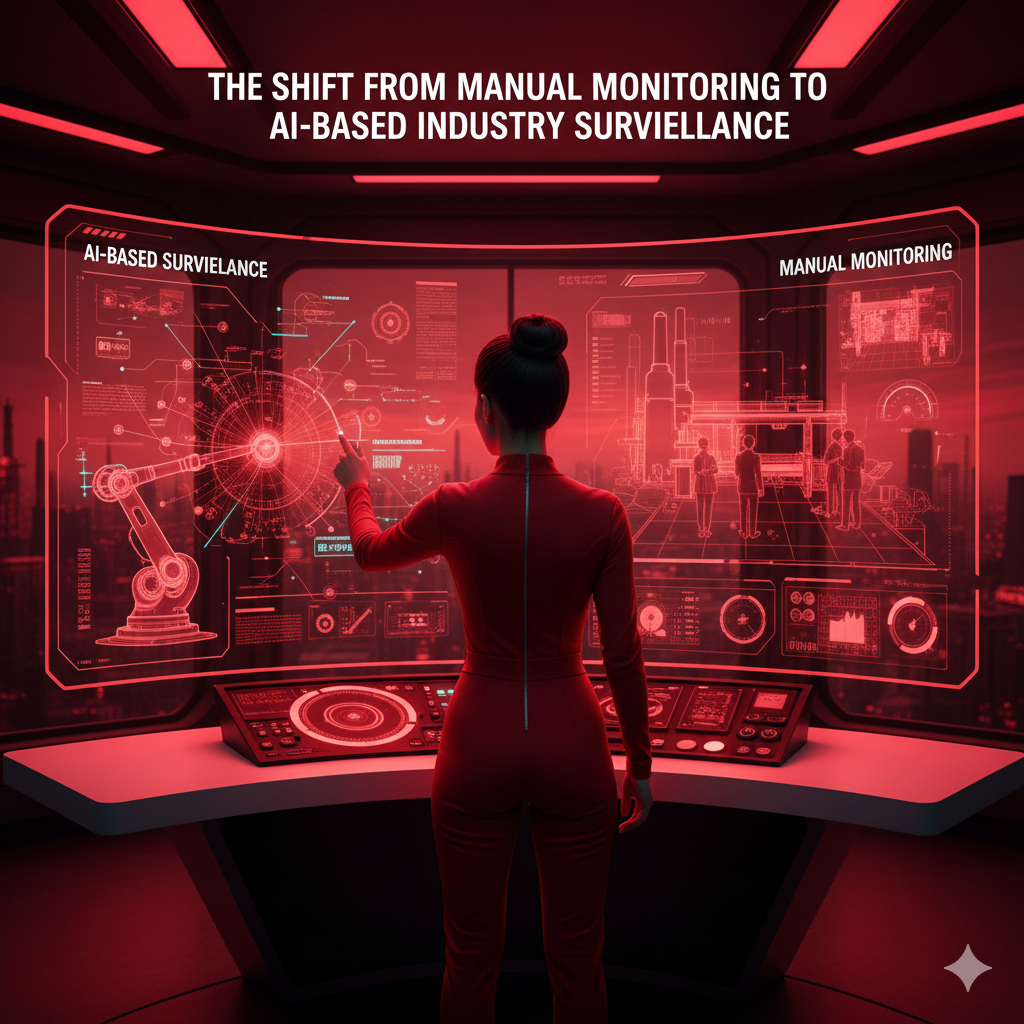
The Shift From Manual Monitoring to AI-Based Industry Surveillance
Manual monitoring has long been the method of choice for industries when it comes to overseeing production lines, equipment, and operational procedures. However, human observation is restricted by factors such as weariness, response time, and subjective assessment, despite the fact that it may discover evident problems. This landscape is being transformed by artificial intelligence-based industrial surveillance, which is delivering continuous and intelligent monitoring that improves safety, efficiency, and decision-making. Because of this transition, firms are now able to spot issues in advance, react more quickly, and improve operations at a larger scale.
Monitoring that is both continuous and real-time
Continuously processing data from cameras, sensors, and machines, artificial intelligence surveillance systems are operational around the clock. These automated monitoring systems, in contrast to manual monitoring, do not suffer weariness or interruptions in focus. The identification of abnormalities in real time, such as deviations in workflow or defects in equipment, guarantees that problems are handled as soon as they present themselves. This ongoing monitoring helps to increase operational dependability and lowers the amount of time spent offline.
Detection of Sophisticated Anomalies
A fundamental component of artificial intelligence surveillance is machine learning algorithms, which enable computers to recognize trends and identify abnormalities that may not be immediately apparent to human operators. Early detection of subtle changes in the behavior of equipment, odd production patterns, or environmental anomalies in the environment is possible. The ability to take preventative measures allows for early detection, which in turn reduces the likelihood of accidents, malfunctions, or operational failures.
Compatibility with Predictive Maintenance Integration
The use of artificial intelligence in surveillance is often combined with predictive maintenance systems. Artificial intelligence is able to identify probable faults in equipment by continually monitoring its performance. This monitoring may identify wear patterns, overheating, or strange vibrations. Maintenance personnel have the ability to act before problems become more severe, therefore avoiding expensive downtime and prolonging the lifetime of equipment.
Improvements in both safety and compliance
Artificial intelligence monitoring helps to increase worker protection, which is a key problem in the industrial sector. In real time, systems are able to identify potentially dangerous actions, hazardous circumstances, or unlawful access. Notifications and reports that are generated automatically guarantee a prompt reaction and ensure that safety rules are adhered to. The use of artificial intelligence decreases the need for human supervision, which improves both safety and regulatory alignment.
Large-scale monitoring that can be scaled across operations
In the case of large-scale facilities or activities that span many locations, human monitoring is often not only difficult but also unreliable. Security systems that are powered by artificial intelligence are able to expand easily, allowing for consistent monitoring across various sites. Dashboards that are centralized provide full insight into operations, which enables uniform monitoring and enables decision-making to occur more quickly.
Mitigating the Effects of Human Error and Operational Gaps
It is possible for human monitors to overlook crucial occurrences owing to factors such as preoccupation, exhaustion, or a restricted monitoring scope. Artificial intelligence surveillance employs a consistent analysis across all processes that are examined, hence reducing the likelihood of concerns being ignored. This guarantees that actions are carried out in a timely manner and with accuracy, hence reducing operational gaps.
Automation of Decision Support and Insights Capabilities
Additionally, artificial intelligence systems provide insights that may be put into action to increase operational efficiency. The information obtained via surveillance is examined in order to pinpoint areas of inefficiency, forecast the likelihood of failures, and improve processes. In order to facilitate actions that are both informed and timely, decision-makers get specific suggestions.
Efficiency in terms of costs and optimization of resources
There is a reduction in the manpower expenses associated with continuous monitoring when the surveillance system is replaced with AI-based surveillance. It is possible to redeploy resources that were previously allocated to observation to activities that are of greater value. Moreover, the early discovery of problems helps to prevent losses that are caused by downtime, accidents, or faulty output, which ultimately results in an improvement in overall cost efficiency.
A Long-Term Effect on the Operations of Industrial Sectors
A fundamental revolution in the way industrial monitoring is carried out is represented by the use of AI-based surveillance. In addition to lowering costs and minimizing the possibility of human mistake, continuous and intelligent supervision improves safety, efficiency, and compliance. As time goes on, artificial intelligence monitoring will eventually become an essential part of smart industrial operations, making it possible to implement proactive management and resilient workflows.