The Future of Carbon Credit Trading: Verification Through AI and Blockchain
The Future of Carbon Credit Trading: Verification Through AI and Blockchain
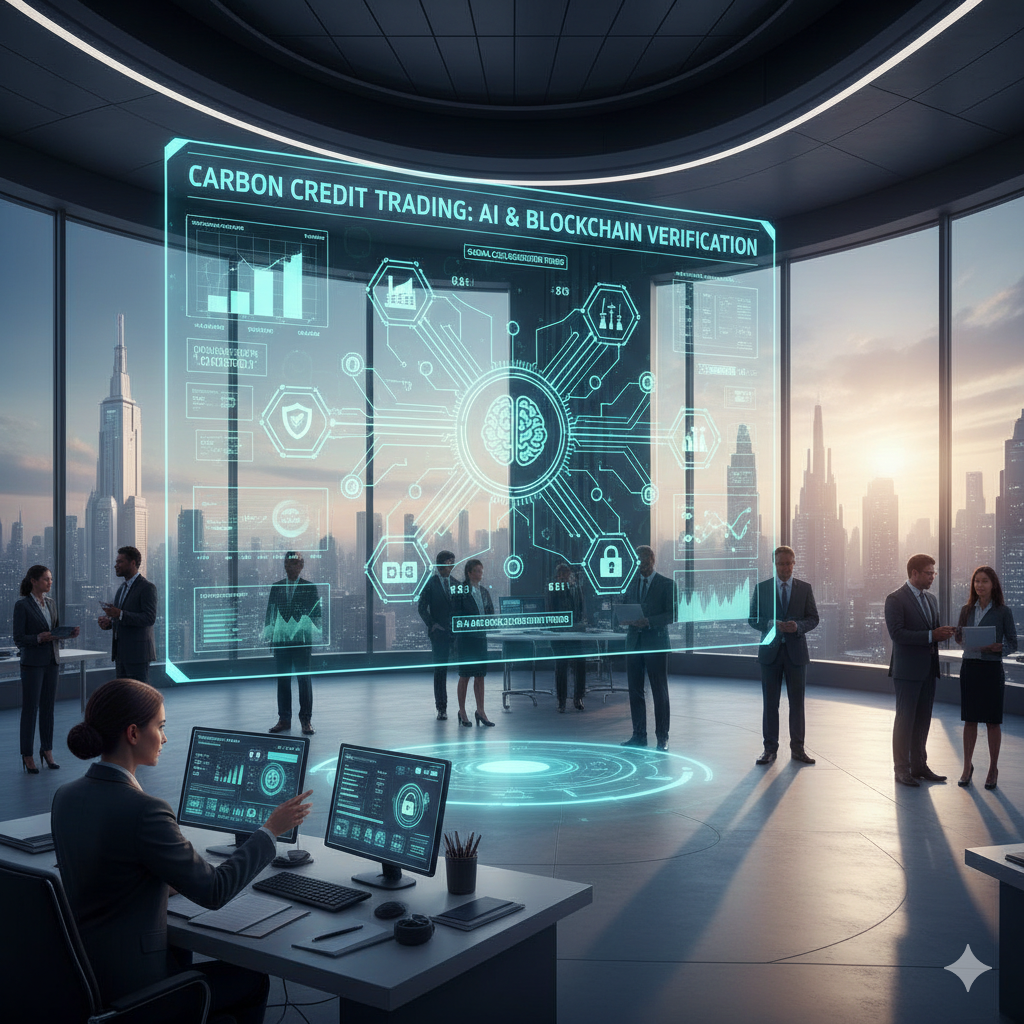
The trading of carbon credits has emerged as an important instrument for reducing the effects of climate change. This technology enables businesses to compensate for their emissions by acquiring certified credits that are created via carbon reduction campaigns, forestry projects, or renewable energy projects. However, assuring the legitimacy, correctness, and transparency of these credits has been a difficulty for a long time. This is due to the fact that existing verification techniques are often manual, time-consuming, and prone to mistakes. The combination of blockchain technology and artificial intelligence has the potential to revolutionize the market of carbon credits by delivering high-quality verification methods that are fully automated. For the purpose of validating carbon reductions, artificial intelligence algorithms examine environmental data, project reports, and emission indicators. Blockchain technology assures that transactions are recorded in a way that cannot be altered and that they can be traced. The integration leads to a rise in the level of confidence in carbon markets, the simplification of verification procedures, and the acceleration of the adoption of emission reduction measures on a worldwide scale.
Verification of Emission Reductions by Artificial Intelligence
A significant part of the verification process for carbon reduction initiatives is the use of artificial intelligence to ensure that these projects generate verifiable environmental benefits. Models that use machine learning examine data obtained from satellite images, sensors connected to the internet of things, and energy systems in order to evaluate changes in carbon emission, forest cover, or the generation of renewable energy. Artificial intelligence has the ability to assure precise quantification of emission reductions by cross-referencing numerous data sources. This helps to reduce the danger of overestimation or false claims. Investors, regulators, and project developers may all benefit from the trust that automated verification provides while also saving time and money.
Blockchain for the Purpose of Keeping Transparent Records
Through the use of blockchain technology, carbon credit transactions may be recorded in an immutable ledger, which guarantees that every credit can be tracked from the time it is issued until it is retired. By storing verification findings and ownership changes on a distributed network, blockchain facilitates the elimination of double-counting, the reduction of fraudulent activity, and the enhancement of transparency. The combination of data that has been validated by artificial intelligence with the secure record-keeping capabilities of blockchain results in the creation of a strong system in which all stakeholders may have faith in the authenticity of the carbon credits that are being sold.
Continuous Monitoring and Reporting in Real Time
Continuous monitoring of carbon reduction initiatives is made possible by artificial intelligence, which also provides real-time insights into the performance of projects and the creation of credits. Artificial intelligence models are fed information from sensors, satellite data, and automated reporting systems. These models evaluate real-time progress and detect any possible inconsistencies. As a result of this real-time capacity, dealers, regulators, and investors are able to validate carbon credits continually, rather than depending exclusively on periodic audits. This improves the market’s trustworthiness and responsiveness.
Methods for Improving the Value of Carbon Credits
The fair value of carbon credits may be determined by using AI algorithms to examine the quality of the project, the efficiency with which emissions are reduced, and the trends in the market. Artificial intelligence achieves more accurate pricing by taking into account a variety of parameters, including the kind of project, the geographic location, and the influence on sustainability. This helps to ensure that high-quality credits are adequately rewarded. Efficient and transparent carbon markets are supported by optimized valuation, which stimulates investment in projects that have the greatest effect on the environment and supports the market for carbon.
Identifying fraudulent activity and managing risks
It is possible to improve fraud detection in carbon trading by combining AI with blockchain technology. Anomalies, suspicious patterns, or inconsistencies in project data may be identified using artificial intelligence, which can indicate that there may have been efforts to double-count or misreport the data. Verifiability and traceability of all transactions are guaranteed by blockchain technology, which eliminates the possibility of illegitimate credit issuance or manipulation. These technologies, when combined, lessen the likelihood of certain outcomes, safeguard the integrity of the market, and boost players’ trust.
Facilitating the Efficiency of the Market
Verification that is powered by artificial intelligence and the incorporation of blockchain technology expedite the process of trading carbon, hence decreasing the administrative load and speeding up transaction settlements. The elimination of human paperwork, the acceleration of project certification, and the simplification of compliance with regulatory requirements are all benefits of automated verification. The players in the market profit from trading that is both speedier and more efficient, while regulators get insight into credit issuance and retirement in real time.
Helping to Ensure Compliance with Regulations
Carbon credits must be subjected to stringent verification in order for governments and environmental organizations to effectively implement policies aimed at reducing emissions. In order to ensure that credits are correct, auditable, and transparent, artificial intelligence and blockchain technology offer tools for compliance. Reporting is made easier, regulatory enforcement is supported, and the risk of disagreements amongst stakeholders is reduced when real-time monitoring and immutable recordings are used.
Enabling Participation on a Global Scale
Through the provision of standardized verification and transparent record-keeping, the marriage of artificial intelligence and blockchain technology makes global carbon markets more accessible. With the knowledge that credits are trustworthy and can be verified, organizations from a variety of nations are able to engage with complete assurance. For the purpose of meeting international climate objectives and scaling up efforts to reduce emissions all across the globe, this accessibility supports a wider acceptance of carbon trading as a strategy.
The Prospects of Artificial Intelligence and Blockchain in the Carbon Markets
As technology advances, artificial intelligence (AI) and blockchain will progressively make it possible to create carbon credit systems that are completely transparent, scalable, and automated. Recent developments in satellite monitoring, Internet of Things sensors, and machine learning models will lead to an increase in the accuracy of verification, while blockchain platforms will enable trade that is both quicker and more safe. These technologies, when combined, have the potential to convert carbon markets into systems that are extremely efficient, trustworthy, and globally linked, therefore accelerating the battle against climate change.