How Independent Coffee Roasters Use AI Temperature Profiling to Ensure Batch Consistency
How Independent Coffee Roasters Use AI Temperature Profiling to Ensure Batch Consistency
Keeping taste profiles consistent between batches is a difficulty that independent coffee roasters encounter on a continuous basis. This is especially true when they are dealing with raw ingredients and ambient circumstances that are changeable. The roasting of coffee is a very delicate process in which even minute variations in temperature, time, and airflow may have a substantial influence on the flavor of the finished product. Experience, manual controls, and sensory assessment have traditionally been the methods that roasters have relied on to regulate these factors. It is possible, however, that this method may result in discrepancies, particularly when it comes to expanding production or training new employees. There is now an introduction of artificial intelligence in order to improve accuracy via the use of temperature profiling and data analysis. In order to ensure that roasting conditions are consistent, artificial intelligence systems monitor them in real time and alter the settings accordingly. When roasters make use of predictive models, they are able to recreate successful profiles with a higher degree of precision. The use of this technology makes it possible for smaller firms to reach a level of consistency that was previously only possible for larger-scale operations. Profiling of temperature using artificial intelligence is becoming an essential element in contemporary coffee roasting.
The Importance of Understanding Temperature Profiling When Roasting Coffee
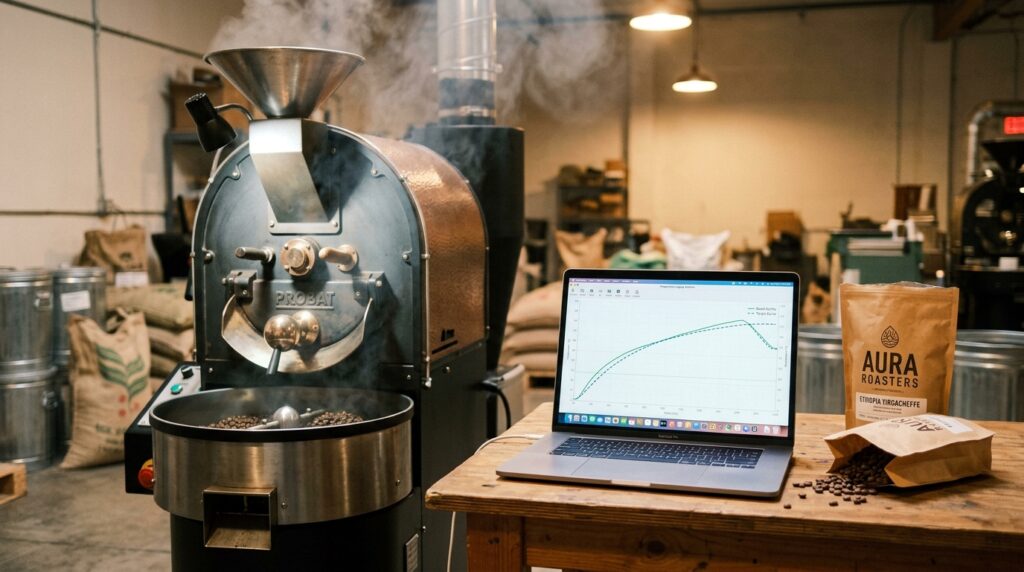
While roasting coffee beans, temperature profiling refers to the technique of gradually increasing the amount of heat that is delivered to the beans in a controlled manner. At each step of the roasting process, from drying to the first crack and development, it is necessary to make exact adjustments to the temperature. Variations in the application of heat have the potential to change taste attributes like as acidity, body, and scent. Manual modifications based on an individual’s experience and observations are the foundation of traditional profiling. By continually monitoring temperature curves and comparing them to optimum profiles, artificial intelligence systems make this procedure more efficient. Sensors gather information on the temperature of the beans, the temperature of the drum, and the parameters of the surroundings. An analysis of these data is performed in order to guarantee that the roasting process adheres to a predetermined course. For the purpose of getting consistent findings, accurate temperature profiling is absolutely necessary. Artificial intelligence offers a method that is more regulated and reproducible for addressing this essential part of roasting.
How Artificial Intelligence Improves the Accuracy of Roasting
The use of artificial intelligence helps to enhance roasting accuracy by evaluating massive amounts of data and making changes in real time. By training machine learning models on successful roast profiles, the system is able to determine the circumstances that are best for roasting. The AI keeps track of the temperature fluctuations that occur throughout the roasting process and makes predictions about how the beans will react. If there are any deviations, the system has the ability to modify the timing, airflow, or heat levels in order to fix the process. When doing things manually, it is impossible to obtain this level of accuracy, particularly when the circumstances are different. Artificial intelligence helps to limit the amount of dependence on guessing and guarantees that each batch adheres to the specified profile. There is a correlation between consistent accuracy and more predictable taste results. Having this capacity improves both the quality of the product and the consistency of the brand for independent roasters. A significant step forward in roasting technology is the use of data-driven control.
Considerations Regarding the Variability of Green Coffee Beans
The origin, processing technique, moisture content, and storage conditions of green coffee beans all have a significant impact on that bean’s characteristics. During the roasting process, these variances may have an effect on how beans react to heat. AI systems are capable of adapting to these variances by assessing the qualities of beans and altering their profiles appropriately. In order to reach the intended outcomes, the system is able to recognize patterns in the behavior of certain beans and make adjustments to the temperature curves. Because of this flexibility, fluctuations in the raw materials do not in any way jeopardize the uniformity of the product. Roasters are able to keep the taste profile consistent even while dealing with various batches of beans throughout the roasting process. AI offers a versatile method for dealing with the management of variability. Particularly helpful for smaller roasters that get their beans from a variety of areas is this opportunity. A fundamental advantage of integrating AI is that it can provide consistent output while having changing input.
Continuous monitoring and feedback loops in real time
For artificial intelligence temperature profiling systems, real-time monitoring is an essential component. For the purpose of putting this information into the AI model, sensors continually gather data on temperature, airflow, and roasting time. Instantaneously, the system processes this data, so establishing a feedback loop that enables immediately applicable modifications. In the event that the roasting curve starts to diverge from the desired profile, measures to remedy the deviation are implemented without delay. Consequently, this guarantees that the process will continue to be steady and under control. Another benefit that roasters get from real-time input is the opportunity to gain thorough insights into each batch. It is possible to make use of these insights in order to refine profiles and develop future performance. Continuous monitoring allows for a reduction in the likelihood of mistakes and inconsistencies occurring. It makes it possible to have a roasting environment that is more sensitive and controllable.
Lessening the Impact of Human Error and Dependence on Skill
Manual roasting is a process that strongly depends on the expertise and experience of the person doing the roasting, which might result in variations. There are variations in method, timing, and decision-making that may have an impact on the results of batches. By establishing a standard for the roasting process, AI helps to eliminate this reliance. Controls that are automated guarantee that the necessary parameters are preserved in a consistent manner between batches. This not only lessens the effect of human mistake but also makes it possible for staff members with less expertise to deliver high-quality output. It is especially crucial for firms that are expanding to take this into consideration while expanding their operations or training new staff. Artificial intelligence functions more as a support system that augments human capabilities than it does to replace it. Roasters may maintain quality consistency by reducing the amount of variability in their products. In order to construct a trustworthy brand, standardization is very necessary.
Achieving Greater Efficiency While Cutting Down on Waste
The inconsistency of the roasting process might result in the loss of batches, which in turn raises expenses and decreases profitability. By verifying that each batch satisfies quality requirements, artificial intelligence temperature profiling helps to reduce the likelihood of this danger occurring. It is less likely that the roast will be under- or over-roasted because to the system’s ability to maintain exact control over the roasting process. This results in a more effective use of the source resources. The elimination of unneeded heating cycles is another way that better roasting profiles may cut down on energy use. A reduction in operating expenses is the direct result of increases in efficiency. When it comes to self-employed roasters, minimizing waste is very necessary in order to preserve profits. Artificial intelligence (AI) offers a workable option that can help achieve both quality and efficiency. More efficient use of resources is beneficial to environmentally responsible corporate strategies.
Integration with Other Software and Equipment Used for Roasting
It is common practice to include artificial intelligence temperature profiling technologies into contemporary roasting equipment and software platforms. This integration makes it possible for sensing devices, control systems, and data analysis tools to communicate with one another in a smooth manner. Digital dashboards provide roasters with the ability to examine both real-time data and historical performance information. Roasting machines also have the capability of having automated controls applied directly to them, which guarantees accurate execution of profiles. Integration also makes it possible to store data and conduct analysis for the purpose of continuous improvement. Roasters are able to evaluate several batches and make adjustments to their procedures depending on the information gained. The linked method improves both control and visibility throughout the whole process. The use of integrated systems may streamline corporate processes and enhance decision-making for smaller companies. To get the most out of artificial intelligence, technology integration is essential.
The Emerging Trends in Artificial Intelligence-Driven Coffee Roasting
Improvements in artificial intelligence and data analytics are having an increasingly significant impact on the future of coffee roasting. There is an expectation that new technologies will improve the capabilities of artificial intelligence systems, making them more precise and adaptable. It is possible that predictive models may get more advanced, which will enable us to exert even more control over the creation of flavors. Before the roasting process starts, the integration of data from the supply chain might give insights on the quality of the beans. AI may also make it possible to create individualized roasting profiles that are suited to the interests of individual customers. Despite the fact that these advances are becoming more readily available, independent roasters will continue to use contemporary technology. The industry as a whole will see more consistency and an improvement in product quality as a result of this. The development of roasting technologies powered by artificial intelligence offers a substantial change toward accuracy and efficiency.