How Boutique Hotels Use AI Room Occupancy Sensors to Optimize Housekeeping Schedules
How Boutique Hotels Use AI Room Occupancy Sensors to Optimize Housekeeping Schedules
There is a high emphasis placed on providing individualised experiences for guests in boutique hotels, where factors such as cleanliness, punctuality, and the effectiveness of service all play a significant part in determining overall satisfaction. Housekeeping management that is both effective and efficient is vital for these properties since, in contrast to huge hotel chains, they often operate with smaller teams and shorter operating margins. In most cases, traditional cleaning plans are based on predetermined check-in and check-out times, which may not necessarily correspond to the actual amount of time that guests spend in their rooms. It is possible that this may result in inefficiencies, such as cleaning rooms that are already unoccupied too early or delaying service for rooms that are occupied. Room occupancy sensors that are driven by artificial intelligence are revolutionising this process by delivering real-time data into how rooms are being used. These sensors are able to determine if a room is occupied or unoccupied, which enables hotels to dynamically optimise their cleaning schedules. Through the alignment of cleaning activities with real client behaviour, boutique hotels have the ability to increase both their productivity and the quality of their service. It is becoming more important for contemporary hospitality companies to have access to this technology since it offers both accuracy and flexibility.
Mastering the Artificial Intelligence Room Occupancy Sensor Technology
A mix of motion detection, infrared technology, and machine learning algorithms are used by artificial intelligence room occupancy sensors in order to ascertain whether or not a room is being utilised. These sensors are discretely positioned inside the guest rooms, and they have the ability to continually monitor activities without compromising the guests’ privacy. Systems that are driven by artificial intelligence are able to discriminate between momentary idleness and genuine vacancy, in contrast to basic motion sensors. As an example, they are able to recognise patterns such as a visitor sleeping or leaving the room for a short period of time. A central management system receives the data that is gathered, which is then processed in real time and sent to the system. Staff members at the hotel are able to receive exact occupancy status at any given time thanks to this. The accuracy and dependability of the system are improved over time as it acquires knowledge about common patterns of behaviour shown by guests. This kind of sophisticated monitoring serves as the basis for housekeeping activities that are more responsive. By delivering accurate occupancy data, these technologies remove the element of uncertainty from the process of room management.
Workflows in Traditional Housekeeping Procedures Being Transformed
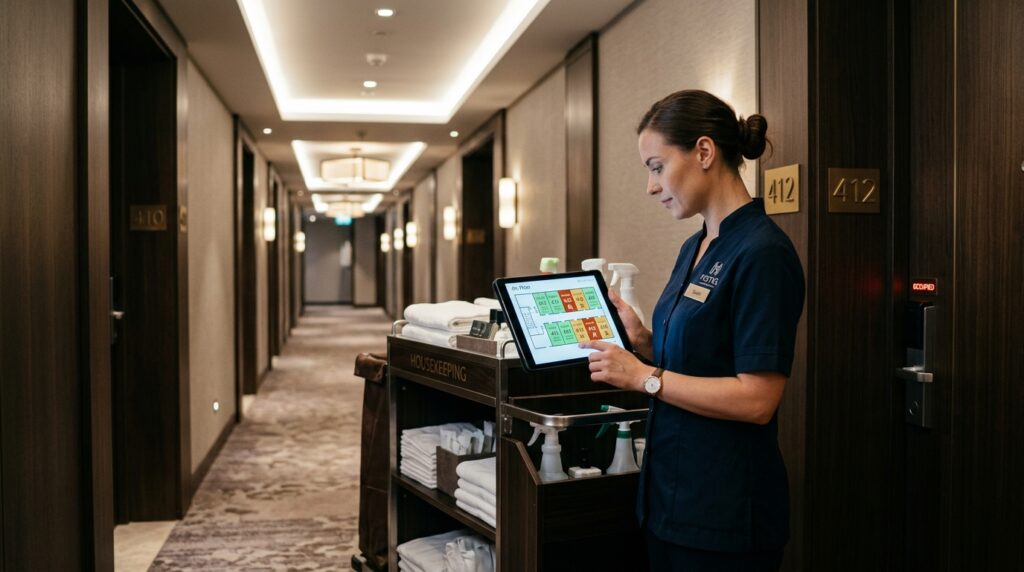
The processes that are traditionally used in housekeeping are primarily dependent on fixed timetables and manual coordination, both of which may result in inefficiency and inadequate communication. Artificial intelligence occupancy sensors allow for dynamic scheduling of shifts depending on the current states of rooms in real time. Staff members who are responsible for housekeeping may get updates that indicate which rooms are unoccupied and ready to be cleaned. Because of this, there is no longer a need to knock on doors or to unsuspectingly disturb visitors. Tasks might be prioritised according to real availability rather than according to timetables that have been planned. By using this strategy, idle time is cut down, and it is ensured that the efforts of the workers are concentrated where they are required the most. Housekeeping personnel are able to get fast alerts and updates thanks to the integration with mobile devices. Increasing the efficiency of hotel operations may be accomplished via the transformation of processes. It is also possible to increase cooperation between departments, such as the front desk and cleaning, by using dynamic scheduling.
Strengthening Productivity While Cutting Down on Labour Expenses
At boutique hotels, where there is a restricted number of employees, efficiency is an extremely important issue. Housekeeping personnel are able to optimise their routes and duty allocation with the use of occupancy statistics powered by artificial intelligence. It is possible for staff members to execute jobs more quickly and with less effort if they concentrate just on the rooms that need attention. Because of this, wasted movement and time spent on things that are not productive are reduced. The end consequence is that hotels are able to manage their operations with fewer resources without sacrificing the quality of their service offering. It is possible to exercise efficient control over labour expenditures, which constitute a significant amount of operating expenses. Additionally, better use of workers and a reduction in overtime are also outcomes of optimised scheduling. These efficiencies, when applied over time, lead to an increase in their profitability. AI technology helps hotels to do more with less resources while yet maintaining high standards.
Increasing the Quality of the Guest Experience Through Prompt Service
Guest satisfaction is directly proportional to the quality of housekeeping services as well as the scheduling of such services. With the help of artificial intelligence occupancy sensors, rooms are cleaned at the most optimal times, hence minimising inconveniences to guests. As an example, it is possible to arrange cleaning to occur when visitors leave the room, rather than at predetermined times. A more streamlined and individualised experience is produced as a result of this. It is less probable that guests may experience difficulties such as having their relaxation disrupted or having their room service arrive late. It is also beneficial for new guests to have clean rooms accessible more quickly, which is why faster room turnover is beneficial. It is possible for hotels to provide a greater level of service by coordinating cleaning with the behaviour of their guests. The entire experience of the guests is improved as a result of this attention to detail. Guests who are pleased with their stay are more inclined to return and to suggest the residence.
Integration of Data in Real Time with Hotel Management Systems
It is possible to increase the efficiency of artificial intelligence occupancy sensors by integrating them with hotel management systems. With the use of property management software, real-time data can be synchronised to present a consistent image of the current state of each room. It is possible for the front desk personnel to more effectively organise check-ins and check-outs as a result of this. Teams responsible for housekeeping may get updated work lists that are based on the most recent occupancy data. Integration also makes it possible to do automatic reporting and monitoring of performance. It is possible for managers to analyse data in order to detect patterns and further optimise operations. During times of high occupancy, for instance, it is possible to make proactive adjustments to the number of staff members. It is via this integrated framework that decisions are made more effectively across departments. Integration that is seamless guarantees that all parts of hotel operations are in sync with one another and operate effectively.
Promoting Environmental Responsibility and Efficient Use of Resources
Artificial intelligence occupancy sensors help to more responsible resource management, which is increasing in importance in the hotel business as sustainability becomes an increasingly essential factor. Hotels are able to cut their use of water, electricity, and cleaning materials by only cleaning rooms when it is absolutely required to do so. This not only lowers operational costs but also minimizes environmental impact. Optimized housekeeping schedules also reduce wear and tear on equipment and linens. AI systems can provide insights into resource usage, helping hotels implement more sustainable practices. It is consistent with the brand identity of boutique establishments that place an emphasis on environmentally friendly principles to use this technology. Both environmental and economical objectives may be effectively supported by effective resource management. The use of artificial intelligence technologies displays a commitment to both innovation and sustainability.
The Obstacles and Things to Take Into Account During Implementation
The adoption of artificial intelligence occupancy sensors needs careful planning, despite the fact that they provide various advantages. For boutique hotels that are on the smaller side, initial installation costs and system integration could be a cause for worry. Ensuring data privacy is also critical, as guests must feel confident that their personal space is respected. Choosing sensors that do not capture identifiable information is essential. Staff training is another important factor, as employees need to understand how to use the system effectively. Technical maintenance and system reliability must also be considered. Despite these challenges, the long-term advantages often outweigh the initial hurdles. Making ensuring that the technology is implemented correctly assures that it will reach its maximum potential. Addressing these considerations is key to successful adoption.
Future Trends in AI-Driven Hospitality Operations
The future of hospitality is increasingly shaped by AI and smart technologies, with occupancy sensors playing a central role. Emerging innovations are expected to enhance sensor accuracy and expand their capabilities. For example, systems may integrate with voice assistants and smart room controls to create fully automated environments. Predictive analytics could enable hotels to anticipate guest needs and adjust services proactively. AI may also optimize other operational areas, such as energy management and personalized guest recommendations. As technology becomes more affordable, adoption will grow among boutique hotels. These advancements will enable properties to deliver highly efficient and personalized experiences. The integration of AI into hospitality operations represents a significant evolution in service delivery. Hotels that embrace these innovations will be better positioned to compete in a rapidly changing industry.