Automating Patient Intake Forms in Small Dental Practices Using AI Document Extraction
Automating Patient Intake Forms in Small Dental Practices Using AI Document Extraction
Small dental offices often deal with administrative inefficiencies, particularly during the patient intake process, which is characterized by the loss of critical time and resources due to the manual processing of forms. The personnel is required to manually evaluate, verify, and enter patient information into management systems whether using traditional paper-based forms or rudimentary digital forms. This procedure is not only time-consuming but also prone to human mistake, which may have an influence on the accuracy of patient data and invoicing. Currently, dental clinics are implementing automated solutions in order to optimize their intake operations. This is due to the advent of artificial intelligence document extraction. In order to swiftly gather and process patient information, these systems make use of sophisticated data recognition for the purpose. Through the reduction of manual intervention, practices have the ability to increase both their operational efficiency and the quality of the patient experience. Additionally, automation promotes a speedier onboarding process, which enables dentists to concentrate more on providing treatment rather than on the administrative responsibilities that they face. As technology becomes more readily available, even very modest practices will be able to incorporate these solutions without having to make large adjustments to their infrastructure.
Explanation of Artificial Intelligence Document Extraction in Healthcare Settings
When we talk about artificial intelligence document extraction, we are referring to the process of using technologies such as machine learning and optical character recognition to automatically recognize and extract important data from documents. Forms for patient intake, medical histories, insurance documentation, and permission forms are all examples of dental practices that fall under this category. Artificial intelligence-powered systems, in contrast to simple scanning technologies, are able to read both organized and unstructured data with a high degree of precision. Within the context of forms, they are able to distinguish handwritten text, typed input, and even checkboxes. Having this capacity enables the digitalization of patient information in a seamless manner, eliminating the need for manual data input. By gaining knowledge from the adjustments and trends that are present in the data, these systems are able to increase their accuracy over time. This implies that healthcare professionals will be able to handle patient information more quickly and with greater accuracy. When it comes to administrative automation in dental settings, the use of AI extraction technologies represents a big step forward.
Several Essential Elements That Make Up an Automated Patient Intake System
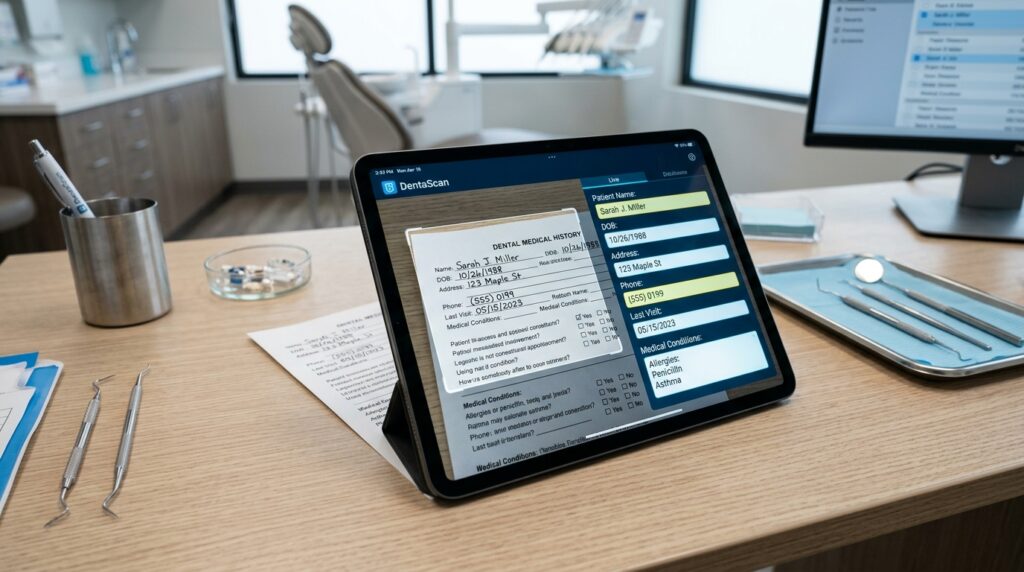
There are a number of interrelated components that make up an efficient automated intake system. These components collaborate to make the data processing process more efficient. At the heart of the system is the document capture mechanism, which enables patients to electronically submit documents by means of tablets, kiosks, or internet portals. After that comes the artificial intelligence extraction engine, which is responsible for processing the papers that have been supplied and determining the relevant data fields, which include the name, contact information, medical history, and insurance details. After that, validation algorithms check the retrieved data to ensure that it is accurate and comprehensive. Additionally, the system is equipped with integration capabilities, which allow the processed data to be sent directly into practice management or electronic health record systems. To guarantee that any inconsistencies are resolved as rapidly as possible, user interfaces for staff inspection and mistake correction are being implemented. The combination of these components results in a unified workflow that reduces the amount of manual labor required and speeds up the process of patient onboarding.
Efforts to lessen the burden of administrative work and human error
When it comes to small dental offices, one of the most resource-intensive duties is manual data entry. This activity often requires devoted staff time and careful attention to detail due to its complexity. By automating the process of capturing and entering patient information, artificial intelligence document extraction greatly minimizes the stress of this task. This not only frees up staff members to concentrate on activities that are more important, but it also lessens the possibility that mistakes will occur as a result of exhaustion or overlooked details. The maintenance of trustworthy patient records, as well as the appropriate invoicing and insurance claims, are all dependent on accurate data input. It is possible for automated systems to do a cross-check of information against established criteria, therefore highlighting discrepancies for further examination. The profession as a whole benefits from increased data integrity thanks to this level of accuracy. As time passes, the decrease in mistakes results in a reduction in the number of administrative corrections and an improvement in the efficiency of operations. The outcome is a more streamlined process, which is beneficial to both the personnel and the patients.
Facilitating a Quicker Check-In Process to Improve the Patient Experience
At the moment of intake, the patient experience starts, and prolonged wait periods or the completion of forms in a repetitious manner may have a detrimental influence on the patient’s level of satisfaction. Patients are able to submit paperwork online before their visit or rapidly on-site with the help of AI-powered intake systems, which streamlines this procedure. When the information is entered, it is processed immediately, which considerably cuts down on the amount of time needed for check-in. Patients are no longer need to repeatedly fill out the same information since it is now possible to save and reuse sensitive data in a safe manner. The availability of this convenience results in a more contemporary and effective experience that is in line with the expectations of the patient. By reducing the amount of congestion in waiting areas, faster check-in also improves the flow of patients around the clinic. Through the reduction of administrative delays, dental offices are able to give patients with an experience that is more streamlined and professional. There is a correlation between this and increased patient retention as well as favorable word-of-mouth.
Integration with Electronic Health Record and Practice Management Systems
AI document extraction must be able to interface without any problems with the practice management and electronic health record systems that are already in place in order to give the greatest amount of value. Through this integration, the gathered data is guaranteed to be automatically supplied into the proper fields without the need for any involvement from a human. Real-time synchronization gives staff members the ability to access up-to-date patient information, which in turn enables them to better coordinate their efforts and make decisions. Compatibility with pre-existing software lessens the need for significant system overhauls, which in turn makes adoption more feasible for smaller practices. User interfaces (APIs) and cloud-based solutions make it easier for systems to communicate data with one another. The maintenance of consistent and organized information is another way that integration helps ensure compliance with healthcare data standards. Taking this integrated strategy helps to improve the overall efficiency of the digital environment that the practice utilizes. As a consequence of this, dental clinics are able to make progress toward a unified workflow that is capable of supporting both administrative and clinical activities.
Certain Considerations Regarding Data Security and Compliance
Data protection is an essential component of the implementation of artificial intelligence since the handling of patient data necessitates a stringent adherence to privacy and security rules. For the purpose of protecting sensitive information, automated intake systems are created with encryption methods and secure data storage. The implementation of access restrictions guarantees that only authorized individuals are able to see or make changes to patient data. For the purpose of ensuring compliance with healthcare standards, audit trails and standardized data processing techniques are required. The monitoring of odd access patterns is another way that AI systems might assist in the identification of possible security threats. It is possible for small dental offices to limit the risk of data breaches and develop trust with their patients by using safe artificial intelligence technologies. Monitoring of the system and performing regular upgrades are two more ways to strengthen security measures. By placing a high priority on data security, practices are able to reliably use AI technology without potentially jeopardizing the anonymity of their patients.
Potential Financial Consequences and Return on Investment
Although there is an initial expenditure required to adopt AI document extraction, the long-term financial advantages often surpass the expenses throughout the implementation process. Practices are able to reduce their administrative costs and more efficiently reallocate their staff resources if they reduce the amount of physical work they do. There is a correlation between faster processing times and improved patient throughput, which may lead to a rise in income. The reduction of billing mistakes and claim rejections, which leads to an increase in cash flow, is another benefit of better data input accuracy. A great number of AI solutions have price structures that are scalable, which enables smaller practices to employ technology while adhering to their financial limits. It is through the reduction of operating expenses and the enhancement of efficiency that the return on investment becomes apparent. By optimizing procedures and reducing inefficiencies, the technology will eventually pay for itself over the course of many years. AI-driven automation is a strategic investment for dental offices that want to develop in a way that is environmentally responsible.
Outlook for Artificial Intelligence in the Administration of Dental Practices
As technology continues to advance, it is anticipated that artificial intelligence will play a considerably larger role in the administration of dental practices. Additionally, in order to manage increasingly complicated patient interactions and paperwork, it is possible that future systems may contain extensive natural language processing. The use of voice-enabled data capturing and real-time analytics has the potential to significantly improve both efficiency and decision-making. Additionally, AI may offer predictive insights, which may assist medical practices in anticipating the requirements of patients and optimizing scheduling. Different systems inside a clinic will become increasingly linked as interoperability increases, which will result in the creation of a digital environment that is all-encompassing and integrated. One way for smaller dental offices to obtain a competitive edge is to incorporate these advances as soon as they become available. The transition toward automation is not just about increasing efficiency; it is also about providing a greater level of care to one’s patients. The influence that artificial intelligence will have on dental procedures will continue to expand as it gets more advanced, which will continue to shape the future of patient care.