How AI Helps Farmers Manage Irrigation and Reduce Water Waste
How AI Helps Farmers Manage Irrigation and Reduce Water Waste
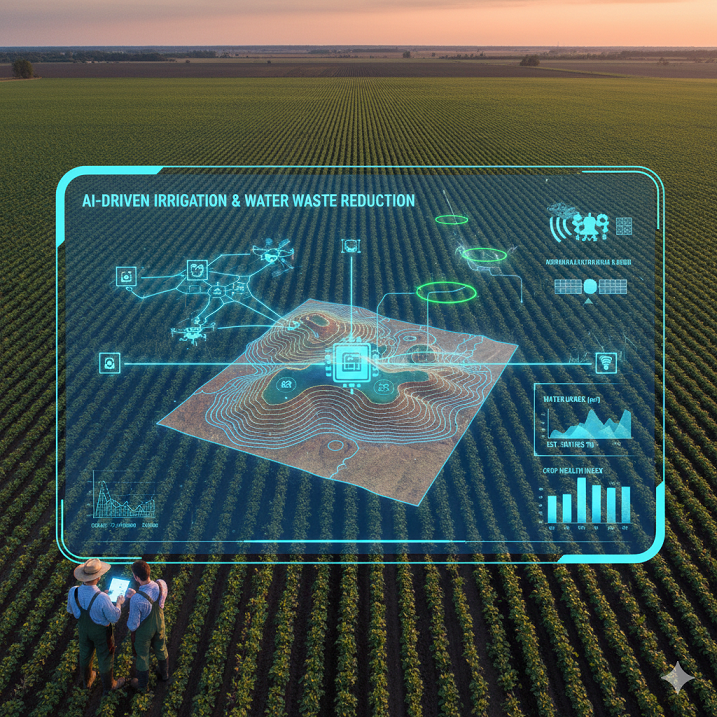
Managing water in an effective manner is a significant difficulty for contemporary agriculture, especially in light of the fact that climate change, population increase, and the depletion of resources are all factors that are increasing the amount of strain placed on freshwater supplies. Overwatering, underutilization, and decreased crop yields are all potential outcomes of traditional irrigation techniques, which often depend on predetermined timetables or visual evaluations. Using environmental data, soil conditions, crop requirements, and weather predictions, artificial intelligence has emerged as a game-changing tool for improving irrigation. This is accomplished via the optimization of irrigation. In order to guarantee that crops are given the appropriate quantity of water at the appropriate time, systems that are powered by artificial intelligence offer exact suggestions for watering schedules, quantities, and procedures. Artificial intelligence not only helps to preserve water thanks to its ability to cut down on waste and improve efficiency, but it also improves crop health, reduces operating costs, and adds to the implementation of sustainable agricultural methods.
Performing a Soil Moisture and Crop Needs Analysis
Artificial intelligence systems gather data on soil moisture in real time by using sensors that are distributed throughout agricultural areas. Algorithms that learn via machine learning examine this data in conjunction with crop-specific water needs, development phases, and ambient factors. Both over-irrigation, which wastes water, and under-irrigation, which strains plants, may be avoided with the use of artificial intelligence (AI), which can compute the appropriate quantity of water to apply by analyzing both the present status of the soil and the requirements of the crop. Utilizing this strategy, which is driven by data, increases water efficiency and guarantees that crops are healthier and more productive.
Combining the Predictions of the Weather
The requirements for irrigation are substantially impacted by the weather conditions. In order to make dynamic adjustments to irrigation schedules, artificial intelligence takes into account local and regional weather forecasts, which takes into account rainfall projections, temperature, humidity, and wind patterns. By way of illustration, if precipitation is anticipated, the system might postpone or minimize the amount of watering, so preserving water resources. Farmers are able to plan irrigation more effectively with the use of predictive analysis of meteorological events, which helps them reduce water loss and ensure constant crop development even when the circumstances themselves are changeable.
How to Make the Most of Irrigation Scheduling
Artificial intelligence-driven irrigation systems provide accurate watering plans that take into account the variability of the field, the kind of crop, and the consumption habits of the past. It is possible to fine-tune these schedules so that water is delivered at the most effective periods of the day, such as early in the morning or late in the evening, in order to restrict evaporation and increase absorption. The use of dynamic scheduling guarantees that irrigation is in accordance with the real demands of the plant and the soil, as opposed to adhering to strict schedules. This results in more effective use of water and increased crop yields.
Irrigation Systems and Automation That Are Intelligent
The most recent artificial intelligence solutions are able to interact with automated irrigation systems, like as drip or sprinkler systems, in order to administer water precisely in accordance with the suggestions produced by the AI. By reducing the need for manual intervention, ensuring equal coverage across fields, and preventing human mistake that might result in overwatering or missing zones, automation helps to decrease the need for manual intervention. Irrigation that is controlled by artificial intelligence offers farmers the opportunity to save both time and money on labor costs.
Searching for Inefficiencies and Unusual Occurrences
Leaks, blocked nozzles, and uneven water distribution are all examples of inefficiencies that may be identified using artificial intelligence in irrigation systems. Artificial intelligence is able to identify possible problems at an early stage by monitoring sensor data and comparing actual water application to projected patterns. The prevention of water loss, the maintenance of regular crop hydration, and the maintenance of overall system performance are all achieved via the detection and resolution of these abnormalities. Enhancing resource management and cutting down on operational waste are both outcomes of continuous monitoring.
Improvements to the Management of Water Resources
Artificial intelligence assists farmers in making more sustainable use of water resources by improving irrigation operations. Consuming less water reduces the strain placed on local water resources, which in turn helps to preserve ecosystems and ensures the continued profitability of agriculture over the long term. There is a reduction in the amount of energy that is required to pump and transport water when water is used efficiently, which further contributes to the environmental and economic advantages of water efficiency.
Providing Assistance for Precision Agriculture
Irrigation that is controlled by artificial intelligence is an essential part of precision agriculture, which seeks to increase crop yields while minimizing expenditures on resources. An artificial intelligence system may deliver site-specific suggestions for water management by combining data on the soil, crops, and weather. This level of accuracy guarantees that every portion of a field gets just what it requires, which results in an increase in production, a reduction in water use, and an increase in the profitability of the farm.
Continuous Education and Adjustment to Change
The input from sensors, the effects of irrigation, and changes in the environment are all sources of continual learning for AI systems. The accuracy of suggestions is improved over time as a result of algorithms’ ability to adapt to changes in the kind of soil, crop performance, and climatic circumstances under which they operate. By ensuring that irrigation techniques develop with changing conditions, continuous learning guarantees that efficiency and water savings are maintained year after year.
At the same time as lowering costs, increasing sustainability
Through the optimization of water consumption, the reduction of waste, and the prevention of crop stress, artificial intelligence-driven irrigation helps to reduce operating costs and improve sustainability. Farmers are able to enhance their yields, lower their water expenses, and save money on their energy bills, all while making a contribution to the preservation of the environment. Artificial intelligence will become an indispensable instrument for the development of contemporary, sustainable practices if it is combined with data-driven insights, automation, and ongoing learning.