AI-Driven Route Optimization vs Traditional GPS for Local Florist Delivery Fleets
AI-Driven Route Optimization vs Traditional GPS for Local Florist Delivery Fleets
To ensure that their customers are satisfied, local florist firms depend largely on delivery operations that are both fast and efficient. This is particularly true for situations in which timeliness is of the utmost importance. Historically, delivery drivers have relied on more conventional GPS navigation systems in order to determine the routes that are either the shortest or the quickest. In spite of the fact that these systems are powerful for general navigation, they sometimes lack the level of complexity required to manage numerous deliveries that are subject to dynamic limitations. Through the analysis of various factors in real time, artificial intelligence-driven route optimization is developing as a game-changing solution that has the potential to go beyond basic navigation. The use of this technology has the potential to greatly enhance efficiency and cut down on operating expenses for florists who manage daily delivery batches. Businesses have the ability to build more intelligent routes by using sophisticated algorithms, which take into consideration factors such as traffic, delivery priority, and time windows. This change is especially beneficial for smaller florist fleets that are operating with less resources than larger franchises. Because of the growing level of competition, the implementation of intelligent routing solutions is becoming more necessary in order to preserve both dependability and profitability.
In the context of delivery operations, an understanding of traditional GPS navigation
Traditional global positioning systems are intended to deliver instructions in a step-by-step format, with the goal of determining the quickest or shortest route between two sites. This capability is often adequate and dependable for excursions that are taking place on an individual basis. But when it comes to optimizing the entire route sequence, standard GPS is not up to the task when it comes to delivery fleets that have many stops. There is a common need for drivers to manually determine the sequence of deliveries, which may result in inefficiencies and an increase in travel time. In addition, these systems are dependent on data that is either static or semi-dynamic, which means that they may not be able to completely adjust to changes that occur in real time, such as unexpected traffic jams or road closures. When it comes to florist firms that deal with time-sensitive deliveries like fresh bouquets, these limits might have an effect on the quality of service such organizations provide. Despite the fact that GPS continues to be an essential tool, it does not provide the sophisticated planning skills that are necessary for delivering complicated packages. This creates a need that artificial intelligence-driven solutions intend to fill.
The Process Behind the AI-Driven Optimization of Routes
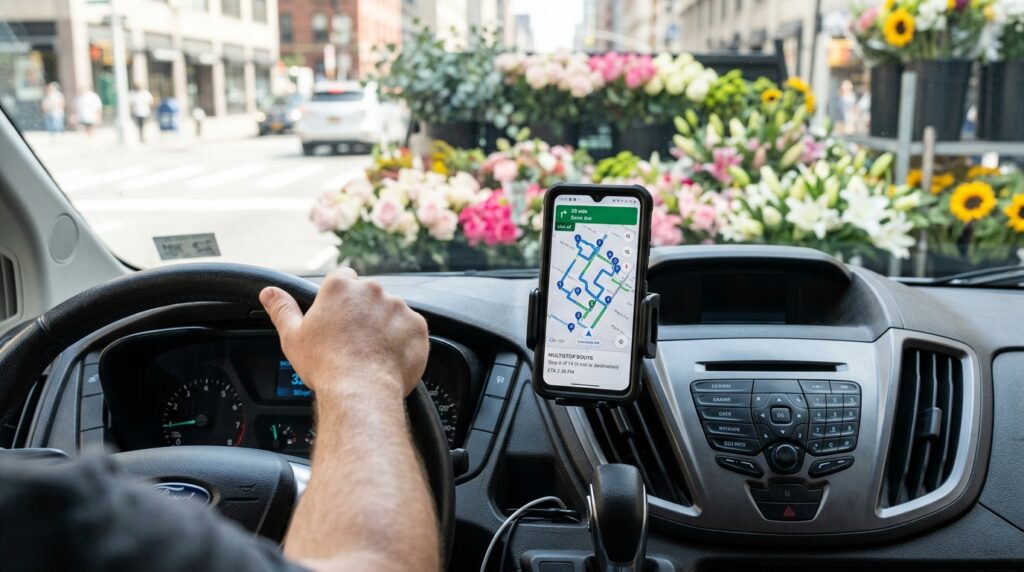
Optimization of delivery routes powered by artificial intelligence makes use of machine learning algorithms and sophisticated analytics to identify the most effective order in which delivery trucks should make their stops. This GPS system, in contrast to typical GPS systems, takes into account numerous factors at the same time. These variables include delivery time frames, traffic conditions, distance, vehicle capacity, and priority orders. In order to develop optimum routes that save travel time and fuel consumption, the system analyzes both historical and real-time data. It also has the capability to dynamically adapt routes in response to changes in circumstances throughout the day. Suppose, for instance, that there is an increase in the amount of traffic congestion on a certain road, the system is able to instantaneously redirect vehicles. It is because of this level of flexibility that deliveries are able to continue on time even when the circumstances are unexpected. This results in more efficient and dependable service for florist fleets, as well as more fresher items. Routeing, which was formerly a manual procedure, is now a data-driven, automated process thanks to the intelligence that is behind these systems.
Important Advantages for Florist Delivery Fleets in the Local Area
Several real advantages are available to small floral enterprises that use AI-driven route optimization. Improved delivery efficiency is one of the most important benefits, as it enables a greater number of orders to be fulfilled within the same amount of time. This has a direct influence on the potential for income without necessitating the hiring of more people or cars. This results in cheaper fuel expenses and less wear and tear on automobiles, which is another benefit of traveling shorter distances. A further benefit of optimizing the route is that it helps to guarantee that the flowers arrive fresh, which is essential for preserving the quality of the product. florists are able to fulfill tight delivery windows for events and special occasions if they minimize the amount of time that delays occur. The fact that drivers are no longer required to manually plan routes is another way in which the system lessens the mental burden they carry. Because of this, there are fewer errors and the process as a whole runs more smoothly. These advantages, when taken as a whole, improve both the operational performance and the happiness of the customers.
When it comes to multi-stop deliveries, traditional GPS has its limitations.
Traditional global positioning systems are dependable for basic navigation, but they are not built to manage the intricacies of delivery routes that include many stops by multiple vehicles. The inability to automatically sequence several destinations in the order that works best for efficiency is one of the most significant limitations. The majority of the time, drivers depend on their own discretion, which may not necessarily result in the most efficient routes. To add insult to injury, GPS systems often do not take into consideration delivery priorities or time-sensitive limitations. Due to improper routing, this might result in instances in which deliveries that are considered to be urgent are delayed. The limited real-time flexibility of certain systems is still another difficulty, since it may be difficult for them to react swiftly to changing traffic circumstances. These inefficiencies may lead to missed delivery windows and decreased customer satisfaction for firms who are directly involved in the florist industry. A major limitation on the efficiency of standard GPS in dynamic delivery contexts is the absence of predictive capabilities.
Dynamic routing and real-time adaptability are two advantages.
The capacity to adjust in real time is one of the characteristics that distinguish AI-driven route optimization from other approaches. Because of factors such as traffic, weather, or order additions made at the last minute, delivery circumstances are subject to quick change. Artificial intelligence systems remain vigilant in their monitoring of these factors and make adjustments to routes appropriately in order to preserve efficiency. This capacity of dynamic routing guarantees that drivers will always be following the route that is the most optimum among those that are accessible. During peak seasons, such as the holidays, when there is a significant amount of deliveries, this is of utmost importance for florist fleets. There is a correlation between the capacity to react promptly to interruptions and the prevention of delays and the guarantee of timely delivery. In addition, drivers may get real-time information immediately on their mobile devices, which will improve their ability to coordinate responsibilities. This degree of responsiveness is something that conventional GPS systems are unable to deliver to their full potential. As a consequence of this, AI-driven systems provide a considerable advantage in terms of operational efficiency.
Implications for the Satisfaction of Customers and the Accuracy of Delivery
Timing and presentation are two aspects that are strongly related to the expectations of customers in the flower business. Incorrect or late delivery may have a negative influence on the overall experience of the consumer and can be detrimental to the image of the company. Route optimization that is powered by artificial intelligence helps to increase delivery accuracy by ensuring that orders are delivered in the appropriate sequence and within the time frames that have been defined. The chance of delivery being lost or delayed is decreased as a result of this. As an additional benefit, several systems provide clients the ability to see predicted delivery timeframes, which contributes to an increased level of openness. Reliable delivery performance fosters confidence and motivates customers to return for more purchases. The upkeep of a solid reputation is very necessary for the continued success of florists over the long run. Businesses are able to constantly exceed the expectations of their customers and provide a superior quality of service when they make use of artificial intelligence technologies. This results into deeper ties with customers and improved loyalty from those customers.
Efficiency in terms of costs and optimization of resources
Due to the fact that effective route planning has a direct influence on operating expenses, it is an essential component for small floral enterprises. Through the reduction of needless travel and idle time, artificial intelligence-driven optimization helps to cut fuel usage. Additionally, it permits better use of delivery trucks, which enables a greater number of orders to be fulfilled with a minimal amount of resources. As drivers spend less time on the road and more time making deliveries, it is possible to bring down the overall cost of labor. In addition, decreased expenditures for car maintenance and repairs are a direct result of decreased vehicle utilization. These cost reductions, when added up over time, lead to increased profit margins. It is also possible for AI systems to provide insights into performance measures, which may assist firms in determining areas that might benefit from further improvement. The use of this data-driven strategy makes it possible to achieve continual improvement in operations. AI-driven routing offers substantially more considerable cost advantages than standard GPS does. These benefits are significantly more substantial.
In the future, small businesses will see trends in delivery optimization technology.
Artificial intelligence (AI) and automation are becoming more important in the future of delivery optimization. New technologies are expanding capabilities, contributing to this trend. There is an expectation that new technologies, including as predictive analytics and integration of the internet of things, will further improve route planning. For instance, sensors installed in delivery trucks might offer real-time data on the functioning of the vehicle as well as the circumstances of the surrounding environment. Additionally, artificial intelligence systems may include patterns of client behavior in order to forecast demand and improve supply schedules in advance. Through integration with order management and inventory management systems, a workflow that is completely synchronized will be created. Small florist firms will be able to compete with bigger businesses in terms of efficiency and service quality as these technologies become more available to the general public. A substantial paradigm change in the management of delivery has occurred as a result of the development of AI-driven routing options. Companies who are willing to accept these technological improvements will be in a better position to survive in a market that is becoming more competitive.