Reducing No-Show Appointments in Physical Therapy Clinics with AI SMS Triage
Reducing No-Show Appointments in Physical Therapy Clinics with AI SMS Triage
Physical therapy clinics have a chronic difficulty in the form of missed appointments, which results in significant financial losses, disruptions to their schedules, and worse patient outcomes. Conventional reminder systems, such as those that involve making phone calls or sending simple text messages, often fail to address the fundamental reasons why patients do not show up for their appointments. Over the last several years, artificial intelligence-driven text message triage has emerged as a viable approach to address this problem in a more intelligent manner. By integrating automation with conversational intelligence, medical clinics are able to engage patients in a proactive manner and detect possible obstacles before patients skip their appointments. This method goes beyond just reminding patients by providing communication in both directions that is capable of adapting to the reactions of the patients. The use of artificial intelligence text messaging systems is a cost-effective method for improving attendance rates in clinics that are small to medium in size. It is becoming more important to have these technologies available as the expectations of patients move toward ease and responsiveness. The outcome is a scheduling system that is more effective and an overall improvement in the quality of care that patients get.
Utilizing Artificial Intelligence for SMS Triage in Healthcare Communication
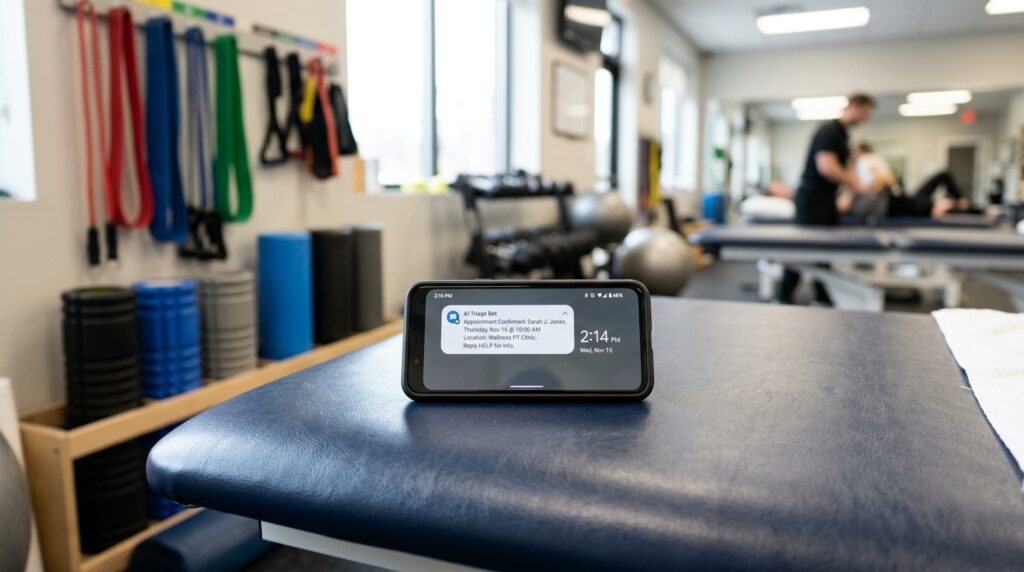
When referring to the management and response to patient interactions via text message, the term “AI SMS triage” refers to the use of artificial intelligence. These platforms, in contrast to static reminder systems, are able to comprehend patient inputs and give context-aware answers in real time. This implies that patients at physical therapy clinics may confirm their appointments, reschedule their appointments, or ask inquiries directly by text message, eliminating the need for them to contact the front desk. The artificial intelligence system examines these interactions and classifies them according to the level of urgency or purpose they contain. For instance, if a patient reports that they are unable to attend due to discomfort or problems with their schedule, the system has the ability to react properly or escalate the problem. With the support of this dynamic contact, clinics are able to remain informed about the goals of patients. Through the passage of time, the system acquires knowledge from the patterns of communication, therefore enhancing its precision and responsiveness. SMS goes from being a tool for sending one-way notifications to being an interactive patient management system when it reaches this level of involvement.
Getting to the Bottom of the Problems That Lead to Missed Appointments
It is necessary for clinics to first have an understanding of the reasons patients do not show up for their visits. Examples of common causes include forgetfulness, problems in scheduling, difficulties with transportation, and doubt over the usefulness of therapy. It is possible for AI SMS triage systems to collect insights by evaluating the answers of patients and recognizing trends that occur repeatedly. In the event that several patients commonly raise schedule issues, for instance, clinics have the ability to change their scheduling methods appropriately. Additionally, the system is able to identify instances of hesitancy or doubt in the responses of patients, which may indicate a need for further explanation or reassurance. Clinics are able to get a more profound comprehension of the behavior of patients when they collect this data in real time. Rather of sending out generic reminders, this makes it possible to use more tailored actions. It is possible to get more effective solutions and higher attendance rates by addressing the underlying reasons of instances of no-shows. The refinement of patient engagement initiatives requires the use of data-driven insights.
The use of intelligent personalization in conjunction with automated reminders
AI improves reminders by adding a layer of customization and optimizing timing, despite the fact that reminders have been around for quite some time. Artificial intelligence systems are able to calculate the optimal timing and frequency for each individual patient based on their previous behavior, as opposed to delivering generic messages at predetermined intervals. It is possible to personalize messages so that they contain particular information, such as the kind of appointment, the name of the therapist, and advice for preparation. Because of this tailored approach, there is a greater possibility that patients will read the message and react to it. At the same time, the system is able to modify the content and tone of the message depending on the preferences of the patient. As an example, some patients could react more favorably to brief reminders, whilst others might be more interested in receiving more specific information. Through the customization of communication, clinics have the ability to enhance patient involvement and decrease the likelihood of missed visits. Patients are more likely to feel valued and educated when they get intelligent reminders.
Resolution of conflicts and real-time rescheduling of appointments
Artificial intelligence SMS triage is able to manage rescheduling in real time, which is one of the most powerful characteristics of this technology. If a patient signals that they are unable to attend an appointment, the system has the capability to provide alternate time slots that are dependent on the availability of those time slots. Because of this, there is no longer a need for having contact with administrative personnel back and forth. Patients have the ability to confirm a new appointment immediately by SMS, which ensures that they get consistent treatment. The technology is also able to prioritize instances that are urgent and alter timetables appropriately on its own. Clinics are able to fill unfilled slots that might otherwise result in lost income if they did not resolve disagreements as rapidly as they do. Utilization of resources and overall efficiency are both improved by this capacity of dynamic scheduling. In addition to this, it improves the overall experience of the patient by offering rapid remedies. A reduction in friction and maintenance of an active appointment pipeline are both benefits of real-time rescheduling.
Facilitating Patient Participation and Accountability Improvements
The establishment of a continuous communication channel is one of the ways that AI SMS triage helps to develop a better level of patient participation. When a patient feels linked to the clinic and supported by the staff, they are more likely to show up for their scheduled sessions. The use of interactive messaging motivates patients to take an active part in the management of their calendars. The system is able to deliver follow-up communications, reminders about treatment objectives, or motivating cues in order to strengthen the commitment of the therapy participant. Having this kind of constant interaction helps to foster a feeling of responsibility and motivates patients to stick to their treatment regimens. Furthermore, patients are able to readily ask inquiries or voice concerns, which assists in addressing problems before they lead to cancellations. Clinics have the ability to enhance their ties with patients by keeping frequent touch. There is a clear correlation between increased involvement and greater rates of attendance as well as improved treatment results.
Lessening the burden of administrative work for the staff at the clinic
Both the management of appointment calendars and the contact with patients may be time-consuming for the personnel at the clinic. Because AI SMS triage automates a significant number of these jobs, staff members are free to concentrate on things that are of more value, such as providing care to patients and interacting with them in person. Without the need for human interaction, the system is able to manage normal questions, confirmations, and rescheduling responsibilities. As a result, administrative teams will see a reduction in the number of phone calls and manual data input that they undergo. Automation of processes guarantees that no communication is overlooked, which results in an increase in total efficiency. It is also possible for staff members to view reports and insights that have been summarized by the AI system, which may help with decision-making. It is possible for clinics to function more efficiently with less resources if they eliminate unnecessary administrative procedures. This is especially helpful for smaller offices that have a limited capacity for staffing.
Assessing Performance and Attempting to Achieve Maximum Attendance Rates
Advanced artificial intelligence technologies provide comprehensive analytics that assist medical facilities in evaluating the efficacy of their communication methods. Tracking metrics in real time allows for the monitoring of things like response rates, confirmation rates, and percentages of people who do not show up. Through the use of these insights, clinics are able to determine what is working and where modifications are more necessary. It is possible, for instance, to prioritize certain kinds of communications if they are the ones that result in a greater number of confirmations. There is also the capability of the system to categorize patients according to their behavior, which enables targeted therapies for high-risk groups. Over time, attendance rates will improve as a result of continuous monitoring and adjustment. Making decisions based on data eliminates the need for guessing, which ultimately leads to more consistent outcomes. Through the use of analytics, medical clinics are able to effectively adapt their strategy and create long-term gains in scheduling efficiency.
AI’s Potential Role in Patient Scheduling and Communication in the Future
The use of artificial intelligence (AI) in patient communication is anticipated to greatly grow as technology continues to advance. There is a possibility that future systems may feature voice interaction, support for many languages, and a more in-depth connection with various electronic health records. Through the use of predictive analytics, medical facilities may be able to detect patients who are at danger of overlooking their scheduled visits before they ever get reminders. Additionally, AI has the potential to tailor communication depending on the health situations of patients and the progression of their therapy. As the level of interoperability increases, the various systems that are present inside a clinic will be able to collaborate without any problems in order to provide a unified experience. With these developments, physical therapy clinics will be able to further minimize the number of patients who do not show up and improve their operational efficiency. In the field of healthcare administration, the change toward intelligent communication is not only a trend but rather a transition that will take place over the long term. Healthcare facilities that are quick to adapt these technologies will be in a better position to provide consistent and high-quality treatment to their patients.