Optimizing Warehouse Aisle Layouts for Regional Distributors Using AI Heatmapping
Optimizing Warehouse Aisle Layouts for Regional Distributors Using AI Heatmapping
In the context of logistics, regional distributors work in contexts where their speed, accuracy, and efficiency have a direct influence on the operating expenses and the level of customer satisfaction. The arrangement of the warehouse is a significant factor in influencing the length of time it takes to choose, pack, and transport things. The conventional method of layout planning often makes use of static assumptions, historical patterns, or human observation, all of which may not accurately represent the dynamism of real-time layout operations. When it comes to visualizing movement patterns and activity levels inside warehouses, artificial intelligence heatmapping is becoming an increasingly potent tool. Through the analysis of data obtained from scanners, sensors, and the movements of workers, artificial intelligence systems are able to discover areas of heavy traffic and inefficiencies in aisle design. Distribution centers are able to improve their layouts with the help of this data-driven strategy, which results in speedier processes and less congestion. The use of intelligent optimization solutions is becoming more necessary as the demands placed on supply chains grow more complicated. With the use of artificial intelligence heatmapping, warehouses may transform from static areas into surroundings that are performance-driven and flexible.
Learn About Artificial Intelligence Heatmapping in Warehouse Operations
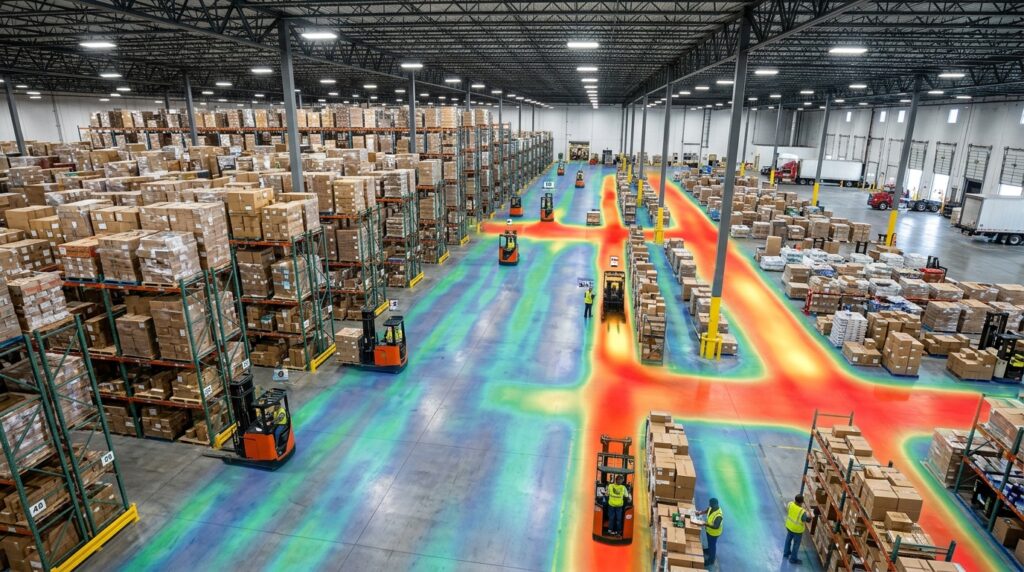
The process of artificial intelligence heatmapping includes the collecting and display of geographical data in order to depict the level of activity that is occurring in various locations of a warehouse. The system creates heatmaps that display the areas of the world that are seeing the most movement by using inputs from barcode scanners, RFID systems, and location-tracking devices. The use of warmer colors often denotes places with a high level of activity, while cooler hues suggest areas that are underused. The management are able to better comprehend how personnel and things move through the facility with the aid of these visual insights. The use of artificial intelligence heatmapping, as opposed to human observation, offers continuous and objective data analysis. It is able to highlight trends such as bottlenecks, regular travel pathways, and zones of idleness. It is essential to have this level of visibility in order to uncover problems with efficiency that may not be immediately apparent. By using heatmaps, distributors are able to get a more comprehensive comprehension of the dynamics of their operations. This should serve as the basis for making well-informed judgments on layout optimization.
The Identification of Bottlenecks and Areas with High Traffic Levels
AI heatmapping has the potential to identify high-traffic regions inside the warehouse, which is one of the most significant advantages of using this technology. More often than not, these zones correlate to objects that are selected often or central passageways that are used by several workers. An excessive amount of congestion may slow down operations and raise the likelihood of mistakes, despite the fact that high activity is not necessarily a bad circumstance. Heatmaps generated by artificial intelligence bring to light bottlenecks, enabling managers to take remedial action. To cut down on the amount of time spent traveling, for instance, goods that are regularly accessed may be moved to areas that are easier to obtain. There is also the possibility of adjusting the width of the aisles in order to handle increased traffic levels. Warehouses are able to increase their workflow efficiency and eliminate delays by addressing bottleneck areas wherever they occur. When it comes to improving overall performance, one of the most important steps is to identify and eliminate bottlenecks. Through the use of this targeted method, resources are sent to the areas in which they are required the most.
Adjusting Product Positioning in Order to Achieve Quicker Picking
There is a substantial relationship between the positioning of products inside a warehouse and the speed and accuracy of picking. Intelligence heatmapping offers insights on the products that are accessed the most often as well as the frequency with which workers transit between different areas. Distributors are able to restructure their inventory in order to reduce the amount of journey distance by examining this data. It is possible to position commodities that are in high demand at packing stations or along key corridors. Products that are accessible less often might be relocated to regions that are more peripheral. The amount of time needed to fulfill orders is cut down thanks to this well considered positioning. In addition, AI systems are able to provide recommendations for ideal slotting techniques by taking into account demand trends and item composition. For instance, things that are often ordered together might be kept together in order to simplify the selection process. The use of this data-driven method decreases worker weariness while simultaneously increasing productivity. In order to get optimal results in warehouse design, it is essential to optimize product placement.
The reduction of travel time and fatigue among workers
An excessive amount of movement inside a warehouse not only slows down operations but also leads to the weariness of workers and a decline in their overall productivity. Using artificial intelligence heatmapping, one may estimate journey lengths and discover movement patterns that are wasteful. Through the analysis of these patterns, managers are able to modify aisle layouts in order to develop paths that are more direct. In order to limit the amount of physical strain that workers experience, shorter travel lengths contribute to quicker picking times. This is especially critical in big warehouses, where even relatively minor inefficiencies may add up to a substantial amount of wasted time and resources. When it comes to safety, improved layout design also improves safety by lowering the risk of accidents occurring in regions with heavy traffic. One way for distributors to improve their performance results is to place a higher priority on the efficiency and well-being of their employees. Not only does the decrease in weariness lead to improved accuracy, but it also adds to fewer mistakes. AI-driven insights make it possible to create a workstation that is more ergonomic and efficient.
Improving the Effectiveness of Space Utilization and Storage Operations
It is necessary to maximize the usage of warehouse space in order to achieve cost efficiency since warehouse space is a precious resource. Heat mapping using artificial intelligence indicates regions that are not being used and might be repurposed for storage or operational tasks. Using activity levels as a basis for redistributing inventory allows distributors to make more efficient use of the space that is available to them. It is possible that this will include reorganizing shelving systems or consolidating products that are in low demand. Utilizing space effectively eliminates the need for expanding the warehouse, which in turn reduces the expenses associated with running the business. It is also possible for AI systems to simulate various layout situations in order to determine which configurations are the most successful. Because of this, managers are able to test changes digitally before really putting them into effect. It is possible for warehouses to obtain a layout that is more balanced and efficient if they optimize both active and idle zones individually. When it comes to preserving scalability and flexibility, effective space management is very necessary.
Integrating Heatmapping with Warehouse Management Systems via Integration
By integrating AI heatmapping with preexisting warehouse management systems (WMS), one may get the most possible benefit. This connection makes it possible to do analysis on data coming from a variety of sources inside a single platform. The use of real-time synchronization guarantees that heatmaps accurately depict the present state of operations. It is possible for managers to use this combined data in order to make well-informed choices about the placement of goods, modifications to personnel, and adjustments to workflow. In addition, integration makes it possible to provide automatic suggestions based on previously established performance measures. For instance, the system may recommend moving objects to a different location or modifying pick routes in order to achieve greater efficiency. Distributors are able to get a full perspective of their operations when they combine heatmapping with Web-based management system features. This comprehensive approach improves both the ability to make decisions and to exercise operational control. Integrating AI-driven optimization in a seamless manner is essential to realizing its full performance potential.
Reductions in expenses and enhancements in their operational performance
Regional distributors may see considerable cost savings and performance advantages as a result of the use of artificial intelligence heatmapping. There is a direct correlation between decreased travel time and increased picking efficiency and decreased labor expenses. Additionally, optimized layouts reduce the amount of time required to process orders, which, in turn, enables quicker delivery and increased throughput. Warehouses have the ability to increase accuracy and minimize returns by reducing the amount of congestion and mistakes that occur. A more efficient use of space reduces the need for extra storage facilities, which in turn results in significant cost savings. The cumulative effect of these enhancements is to increase profitability and provide a competitive edge over time. The provision of continual insights into performance indicators is another way in which AI-driven optimization serves to enhance continuous development. Distributors are able to adjust their operations to accommodate shifting demand and circumstances as a result of this. AI heatmapping is an investment that is worth considering because of the financial and operational advantages it offers.
Innovative Futures in Artificial Intelligence-Driven Warehouse Design
The development of artificial intelligence and data analytics will have a significant impact on the future of warehouse optimization. There is an expectation that new technologies will improve the capabilities of heatmapping systems, hence making them more accurate and predictive. Integration with autonomous robots and intelligent sensors, for instance, might make it possible to follow both personnel and commodities in real time. Additionally, AI models may use predictive analytics in order to anticipate variations in demand and make adjustments to design in a proactive manner. The use of virtual reality simulations might provide managers with the ability to view and test modifications to the layout in different immersive contexts. Regional distributors will be able to work with more efficiency and agility as these advances become more available to the general public. The development of artificial intelligence-driven warehouse design is a noteworthy advancement in the field of supply chain management. The adoption of these technologies by businesses will put them in a better position to face the problems and possibilities that lie ahead in the future.