Using AI Acoustic Monitoring to Detect Early Respiratory Illness in Small Poultry Farms
Using AI Acoustic Monitoring to Detect Early Respiratory Illness in Small Poultry Farms
When it comes to ensuring the health of flocks and avoiding financial losses, small poultry farms work in conditions where early illness identification is of the utmost importance. In particular, respiratory diseases have the potential to spread quickly and can go untreated until the symptoms become severe. Visual inspection and physical observation are the means by which traditional monitoring is carried out; nevertheless, both methods are prone to inconsistency and delay. The development of artificial intelligence has led to the use of acoustic monitoring systems by farmers, which allow them to identify minute variations in the noises made by birds. The early warning indications of disease may be identified by these systems via the analysis of voice patterns, coughing, and breathing anomalies. Artificial intelligence makes it possible to monitor health in a proactive manner by continually recording and analysing auditory data. Small farms, which may not have access to specialised veterinary services, might benefit tremendously from the use of this technology. A reduction in the likelihood of widespread epidemics is one of the benefits of early diagnosis, which also helps to enhance animal welfare. The use of artificial intelligence to acoustic monitoring is making chicken farming a more accurate and preventative process.
Acquiring Knowledge about Computer-Aided Sound Monitoring Technology
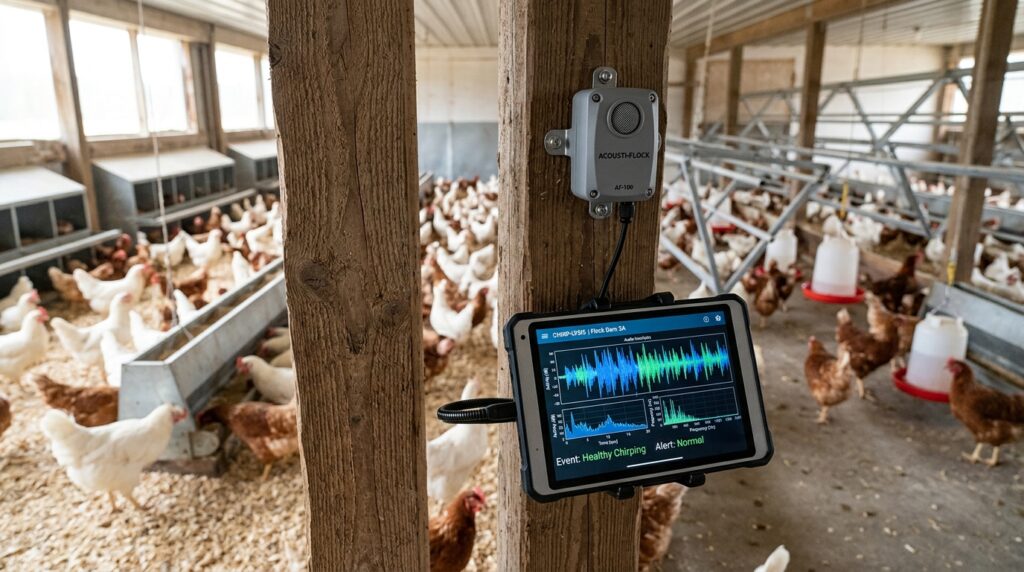
Artificial intelligence acoustic monitoring allows for the analysis of sound patterns inside poultry habitats via the use of microphones and machine learning techniques. In order to get continuous audio data from the flock, sensors are strategically placed in coops or barns according to the objectives. This data is processed by the artificial intelligence system in order to detect certain patterns that are connected with normal and aberrant behaviour. Through the process of training on vast datasets of bird vocalisations, the system acquires the ability to differentiate between sounds that indicate good breathing and noises that indicate respiratory distress. Artificial intelligence has the ability to identify minute changes in Χ features, in contrast to human observation, which may overlook tiny signs. For this reason, it is possible to identify potential health problems at an earlier stage. Without the need for extra labour, the system is able to provide monitoring around the clock since it functions continually. As it becomes more used to the particular circumstances of each farm, its accuracy gradually increases over time. This technology offers a methodology that is both dependable and automated for the purpose of health monitoring.
Learning to Recognise the Initial Symptoms of Respiratory Illness
It is common for respiratory disorders in poultry to express themselves via changes in the sounds of their vocalisation and breathing. The acoustic fingerprints of symptoms such as coughing, sneezing, wheezing, and laboured breathing are diverse from individual to individual. Artificial intelligence systems are taught to recognise these patterns and distinguish them from the typical noise that flocks produce. It is essential to discover the condition at an early stage since the earliest symptoms can not be obvious to the naked eye. Farmers are able to take action before the system continues to spread if they are able to spot these abnormalities. Additionally, the device is able to monitor the frequency and intensity of anomalous noises, which may provide valuable insights on the course of the illness. As a result, a more precise evaluation of the health of the flock is possible. A reduction in death rates and an increase in total production are both outcomes of early intervention. Artificial intelligence acoustic monitoring guarantees that even the most delicate warning indications are not missed.
Continuous monitoring and alerts occurring in real time
One of the most significant benefits of artificial intelligence acoustic monitoring is its capacity to provide alarms in real time. When the technology identifies sound patterns that are not typical, it promptly tells the farmer via dashboards or mobile devices using the information. Quick responses and timely interventions are made possible as a result of this. Even during non-working hours, continuous monitoring guarantees that no significant changes are missed and that nobody is unaware of them. An additional capability of the system is the ability to record data over time, which enables trend analysis and long-term health monitoring. With the support of real-time analytics, farmers are able to make well-informed choices about treatment and management. By using this preventative strategy, the likelihood of surprise breakouts is decreased. Farmers are able to act with confidence when they retain a continual knowledge of the status of their flocks. Monitoring that is ongoing is really necessary for illness prevention that is successful.
Efforts to lessen reliance on manual labour
When it comes to chicken flocks, manual inspection may be a labour-intensive process that may not always discover diseases in their early stages. They often depend on visual cues, which may not become apparent until the illness has progressed to a more advanced stage. Artificial intelligence acoustic systems provide automatic and objective monitoring, which helps to eliminate this reliance. Farmers are able to concentrate on other operational activities while still keeping monitoring of the health of their flocks because to this circumstance. The operation of the system is not hindered by weariness or attention, which guarantees consistency in performance. Through the reduction of dependency on human labour, farms have the potential to enhance their efficiency and precision. In particular, this is advantageous for enterprises that are on a smaller size and have less available labour resources. Management as a whole is improved by the use of automation. By doing so, it guarantees that the monitoring of health is both dependable and scalable.
The Enhancement of Biosecurity and the Management of Disease
It is crucial to use biosecurity measures that are effective. By providing early identification and focused intervention, artificial intelligence acoustic monitoring provides assistance for this Χ Farmers are able to isolate problematic regions or birds in order to restrict the spread of an issue after it has been recognised as a possible problem. This decreases the need for extensive therapy and lessens the likelihood of Μ size. A further capability of the system is the ability to provide insights about environmental elements that may be contributing to the spread of illness. After gaining an awareness of these factors, farmers are able to take measures to mitigate risk. The implementation of enhanced disease control may result in flocks that are healthier and more stable. Using artificial intelligence technologies makes it easier to adhere to stringent biosecurity protocols. This is very necessary for the long-term viability of the farm.
Both cost reductions and increases in productivity
When applied to small poultry farms, artificial intelligence acoustic monitoring has the potential to result in considerable cost reductions. Reducing the need for costly therapies and lowering death rates are both outcomes that may be achieved by early identification of sickness. Better growth rates and increased yields are the outcomes of flocks that are in better health. Additionally, automation decreases the labour expenses that are connected with manual monitoring. Farmers are able to avoid significant financial losses if they take measures to prevent breakouts on a broad scale. Farmers are able to optimise their feeding, environmental conditions, and general management when they have access to vital data that is provided by the system. It is because of these efficiencies that the profitability has increased. When it comes to small farms, it is necessary to maximise the utilisation of resources. Monitoring that is powered by artificial intelligence provides a workable approach for establishing financial stability.
Utilisation of Intelligent Farming Systems Integration
The use of artificial intelligence for acoustic monitoring may be combined with other intelligent agricultural technologies to provide an all-encompassing management system. A comprehensive image of the circumstances on the farm may be obtained via the use of acoustic systems in conjunction with sensors that measure temperature, humidity, and air quality. Because of this integration, analysis and decision-making may be performed with greater precision. For instance, alterations in patterns, when paired with data pertaining to the environment, might potentially suggest certain health hazards. The use of cloud-based systems gives farmers the ability to remotely view and manage their data. Through the use of this integrated strategy, operational efficiency and control are improved. In addition, integration enables the automation of reactions, such as the modification of lighting or ventilation arrangements. Farms are able to reach a better degree of accuracy in their management by merging data from numerous information sources. The future of poultry may be seen in the use of intelligent agricultural technologies.
What’s Next for Artificial Intelligence in Livestock Monitoring?
Even more sophisticated capabilities are anticipated to be brought about by the future of artificial intelligence in cattle monitoring. In order to better the accuracy of analysis and illness identification, advancements in machine learning algorithms will improve their performance. The integration of imaging technologies may make it possible to perform integrated monitoring of both visual and audio data. Additionally, AI systems have the ability to provide predictive insights, which may detect possible epidemics before symptoms manifest themselves. As the cost of decreases, there will be an increase in the usage of this technology among small chicken farms. These developments will make it possible to handle agricultural management in a more proactive and effective manner. The development of artificial intelligence-driven monitoring systems is a noteworthy development in the field of agriculture. When farmers adopt these improvements, they will be in a better position to protect the health of their flocks and to maximise their output.