How Independent Auto Repair Shops Use AI Diagnostics to Reduce Customer Wait Times
How Independent Auto Repair Shops Use AI Diagnostics to Reduce Customer Wait Times
Due to the complexity of car diagnostics and the unpredictability of mechanical difficulties, independent auto repair companies often face the challenge of having to wait for a significant amount of time before helping customers. The traditional methods of diagnosis are primarily dependent on manual inspections, the expertise of mechanics, and testing procedures that take a significant amount of time. It is possible that this may result in a delay in determining the underlying cause of a condition, particularly in cases when symptoms are ambiguous or variable. The need for diagnostics that are both quicker and more accurate has become more critical as the technological sophistication and electrical complexity of automobiles continues to increase. The way that repair shops manage diagnostic procedures is now being revolutionised by artificial intelligence, which works by analysing vehicle data and finding problems in a more effective manner. Diagnostic solutions that are driven by artificial intelligence are able to evaluate sensor data, error codes, and performance trends in order to swiftly identify possible issues. This considerably speeds up the process of repair and decreases the amount of guessing involved. The use of artificial intelligence presents an opportunity for independent repair businesses to enhance their productivity, client happiness, and overall service quality.
Acquiring Knowledge of Artificial Intelligence in Automotive Diagnostics
In automotive diagnostics, artificial intelligence is used to analyse data provided by a vehicle’s onboard systems via the use of machine learning techniques. Through the use of sensors, electronic control units, and onboard computers, contemporary automobiles generate a substantial quantity of diagnostic data. The data is interpreted by AI algorithms, which then look for patterns that point to problems with the mechanical or electrical systems. In contrast to conventional diagnostic approaches, which are dependent on the human interpretation of error codes, artificial intelligence is able to correlate various data points in order to deliver a more precise diagnosis. This allows the system to recognise increasingly complicated problem patterns over time, which is made possible by the system’s ongoing improvement as it analyses more vehicle data. When mechanics use this method, they are better able to discover issues that may not be readily apparent via visual examination alone. Diagnosis based on artificial intelligence minimises uncertainty and enhances the precision of preliminary evaluations. Consequently, this results in repair shops making decisions more quickly and delivering services in a more efficient manner.
By using automated analysis, the diagnostic process may be shortened.
One of the most important advantages of artificial intelligence diagnostics is the huge decrease in the amount of time needed to diagnose problems with vehicles. AI systems analyse data in real time, eliminating the need to manually test each component individually. This allows them to cut down the list of likely reasons. It is because of this that mechanics are able to concentrate on specific inspections rather than general troubleshooting. Additionally, the system is able to evaluate many diagnostic codes concurrently and rank the most probable problems in order of severity. In this way, the amount of time spent on techniques of trial and error is reduced. As a result of faster diagnostics, repair work may start sooner, which further reduces the amount of time that customers have to wait. This enhanced efficiency enables busy repair businesses to complete more automobiles in a single day, which is a significant benefit. The use of automated analysis helps to retain diagnostic accuracy while also increasing the pace of the process. The most immediate benefit of using AI is the reduction in the amount of time spent on tasks.
Enhancing the Accuracy of the Fault Detection Process
When it comes to successful automobile maintenance, accurate defect diagnosis is very necessary. It is possible for a misdiagnosis to result in repairs that are not essential, additional expenses, and dissatisfied customers. In order to achieve more accuracy, artificial intelligence systems examine a broad variety of data points rather than depending on a single error code. They have the ability to recognise connections between various symptoms and figure out the underlying reasons, which may not be immediately immediately apparent. Using AI, for instance, it is possible that a single warning light may be associated with a number of different potential problems, and it helps narrow down the most likely reason. The chance of faulty repairs and further visits is decreased as a result of this. Over the course of time, the system acquires higher accuracy as it acquires knowledge from past instances. A higher level of precision increases the level of confidence that clients have in repair businesses. When it comes to the automobile repair sector, having reliable diagnostics is really necessary in order to have a solid reputation standing.
Improving the Productivity of Workflow Activities in Repair Shops
Artificial intelligence diagnostics integrate with preexisting systems and procedures, which allows them to simplify the whole workflow of vehicle repair companies. After a car has been delivered, diagnostic instruments are able to immediately begin the process of analysing data and producing results. In this way, mechanics are able to prioritise tasks according to the severity and intricacy of the work. In order to reduce the amount of work that has to be done in administration, work orders may be automatically prepared with recommended repair processes. Through the use of digital dashboards, technicians are able to have access to diagnostic information, which will improve communication and coordination. By reducing delays brought on by human processing and information shortages, this organised approach helps to lessen such delays. It is possible for shops to function more smoothly and manage bigger amounts of work when they have workflows that are efficient. The diagnosis phase, which is often the most time-consuming aspect of the repair procedure, may be made more efficient with the use of artificial intelligence. There has been a considerable improvement in the overall operating efficiency.
Efforts to Reduce Wait Times for Customers While Improving Their Experience
When it comes to vehicle repair, the speed and accuracy with which problems are treated are directly related to the level of customer satisfaction. A decline in faith in the quality of service might be a result of long wait periods, which can lead to frustration. Using artificial intelligence diagnostics, this problem may be immediately addressed by expediting the discovery of vehicle faults. Customers get more timely information on the timings and prices of repairs when diagnostics are performed more quickly. Through increased transparency, communication is enhanced, and ambiguity is reduced. Customers are more inclined to become repeat customers of businesses that give service that is both efficient and dependable. Wait times that are shorter also boost throughput, which enables businesses to service a greater number of customers. The total consumer experience is improved by artificial intelligence since it improves both speed and accuracy. Customers who have positive experiences are more likely to remain loyal to a brand and speak positively about it to others.
Utilising Data-Driven Insights to Provide Assistance to Mechanics
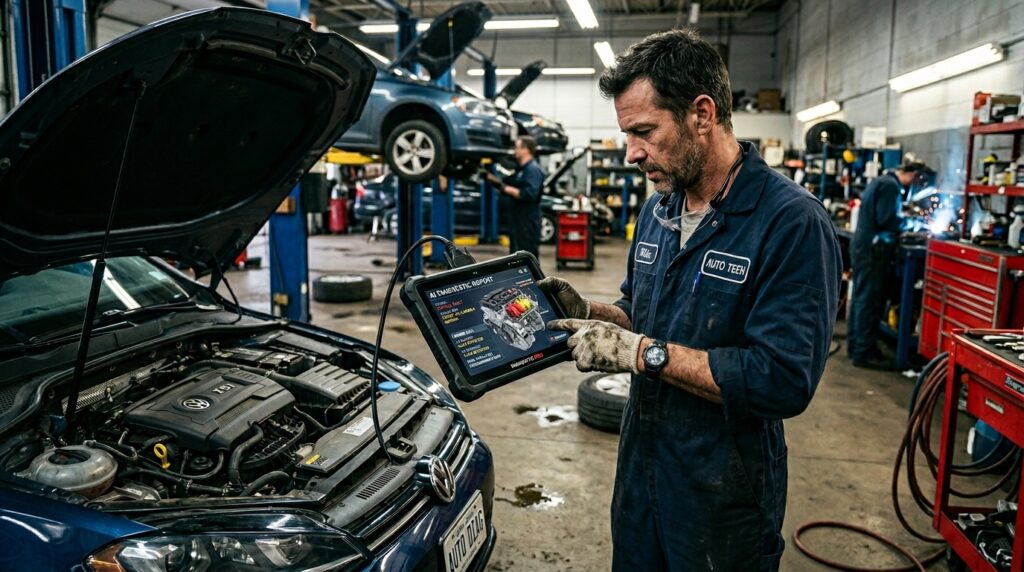
In order to facilitate improved decision-making, artificial intelligence systems provide mechanics precise insights that are powered by data. It is possible for technicians to utilise reports created by artificial intelligence to guide their work rather of depending exclusively on their experience or intuition. These reports provide information on possible causes, tests that are advised, and possible remedies for repairs. Consequently, this enables mechanics with less expertise to function more successfully while simultaneously providing assistance to more experienced experts. Artificial intelligence functions more as a diagnostic assistance than a substitute, therefore augmenting human competence. Better results are achieved when human expertise is combined with the analytical capabilities of machines. Instead of spending an inordinate amount of time identifying issues, mechanics are able to concentrate on finding solutions to those difficulties. Data-driven insights boost both confidence and efficiency in the decision-making process about repairs. Through the use of this collaborative method, the total shop performance is improved.
Bringing down the costs of operations while simultaneously raising the profits
Artificial intelligence diagnostics have the potential to reduce costs for independent repair businesses as well. Shops are able to do more works in less time if they reduce the amount of time spent on diagnostics and improve their accuracy. Because of this, the potential for income is increased without the need for extra labour. When there are fewer incorrect diagnoses, the cost of superfluous parts and repeated repairs is also reduced. Workflows that are efficient minimise the amount of time spent idle and enhance resource utilisation. The increased profitability that results from these improvements accrues over time. Artificial intelligence technologies can assist in optimising inventory management by determining items that are widely required. This improves supply chain planning while also lowering the expenses of storage. These financial advantages are especially significant for companies that are located in smaller firms. Implementing AI technology offers a number of benefits, one of which is cost effectiveness.
Emerging Trends in Artificial Intelligence Automotive Repair
It is anticipated that the future of automobile diagnostics will become even more sophisticated as a result of ongoing advancements in artificial intelligence. Developing technology could make it possible to monitor vehicles in real time and get notifications about preventative maintenance. It would be possible for vehicles to automatically notify potential faults before they escalate into more significant concerns. It is possible that repair shops will be able to access worldwide diagnostic databases via integration with cloud-based technologies, which will allow for speedier issue resolution. Through the use of augmented reality technologies, artificial intelligence may potentially develop the ability to provide step-by-step repair instructions. As the evolution of automobiles continues, diagnostic systems will need to be adapted to accommodate these changes. Independent repair businesses who are early adopters of artificial intelligence will be in a better position to compete in a market that is becoming more sophisticated. In the realm of car repair services, the development of artificial intelligence diagnostics marks a significant revolution.