Implementing AI Defect Detection in Low-Volume Custom Apparel Manufacturing
Implementing AI Defect Detection in Low-Volume Custom Apparel Manufacturing
When it comes to satisfying the expectations of customers, low-volume bespoke garment production is subject to a unique set of restrictions, necessitating accuracy, quality, and flexibility. Unlike situations that involve mass manufacturing, these organizations deal with smaller batches that often undergo design revisions. As a result, human quality control is not only time-consuming but also results in variable quality. It is necessary to conduct meticulous inspections in order to identify flaws such as incorrect stitching, irregularities in the fabric, or misalignment of the print. This slows down the manufacturing process. Artificial intelligence-driven defect identification has made it possible for smaller garment producers to automate quality assurance operations with a higher degree of precision. In the process of analyzing clothes in real time, computer vision technologies are able to detect defects that human inspectors could overlook completely. This technological advancement not only enhances consistency but also lessens the amount of rework and waste that is required. The maintenance of high-quality standards is essential for the reputation of a company, especially as the popularity of personalization continues to rise. The use of artificial intelligence to perform inspections provides a scalable option for assuring product quality in manufacturing environments with low volume.
Comprehending Artificial Intelligence-Based Defect Detection Systems
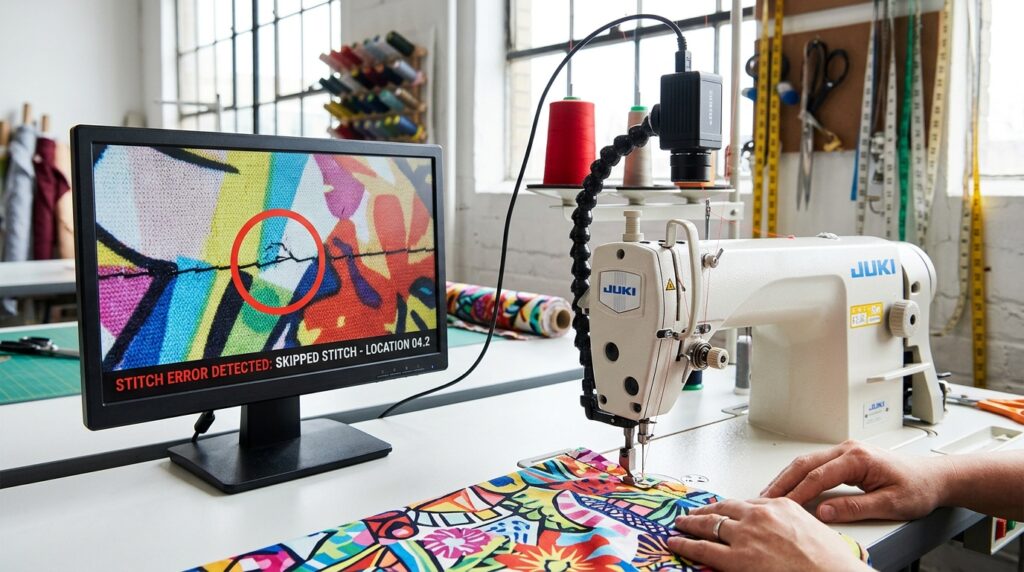
For the purpose of analyzing photographs of garments either before or after manufacture, artificial intelligence defect detection systems depend on computer vision and machine learning models. High-resolution photos of clothing are captured by cameras, and these images are subsequently analyzed by artificial intelligence algorithms that have been taught to identify flaws. By using datasets that include both perfect and faulty samples, these models are able to differentiate between changes that are considered acceptable and those that are really problematic. Artificial intelligence systems, in contrast to human inspection, are able to examine each item with constant accuracy and speed. Despite the fact that they may not be immediately noticeable, they are able to identify tiny flaws like as uneven stitching, rips in the cloth, or color irregularities. Because it analyzes more data, the system is always becoming better, which ultimately leads to an increase in its detecting skills over time. This automated technique guarantees that quality control is both dependable and effective without sacrificing efficiency. Additionally, it offers a technical advantage to smaller firms, which helps them to maintain high standards.
Distinct Categories of Flaws Found in Custom-Made Garments
The creation of bespoke clothing includes a number of different procedures, each of which has the potential to introduce many distinct kinds of flaws. Artificial intelligence systems are able to recognize a broad variety of problems during all of these phases. Stitching abnormalities, such as missed stitches or uneven seams, are among the most common types of flaws. These errors might have an impact on the longevity of the garment. The use of image analysis allows for the detection of issues that are associated with the fabric, such as wrinkles, holes, or discolouration. The identification of misalignment or distortion in patterns that are printed or embroidered may be done with a high degree of accuracy. Artificial intelligence models are also capable of recognizing anomalies in dimensions or form by comparing things to specified templates on their own. They are able to prevent faulty items from reaching consumers if they are able to identify these faults at an early stage. The use of this all-encompassing detection capacity guarantees that every facet of quality is under surveillance. It is crucial to maintain constant quality in order to ensure client happiness and to maintain the integrity of the brand.
Integration into Workflows Within Low-Volume Production Systems
It is necessary to carefully prepare in order to guarantee that there is little disturbance when integrating AI defect detection into low-volume production operations. The deployment of these devices is possible at a variety of phases, including during the sewing process, printing, and the final inspection. It is possible to acquire photos without slowing down production by properly positioning cameras and sensors. The artificial intelligence system analyzes data in real time, therefore giving operators with quick feedback. This makes it possible to resolve errors at an earlier stage in the manufacturing cycle, before they reach a more advanced stage. Data flow and reporting are both made more easy by integration with preexisting production management systems. Cloud-based solutions provide flexibility and simplicity of installation, making them ideal for small-scale commercial enterprises. It is possible for manufacturers to improve their productivity without sacrificing their ability to customize their products by integrating AI into their everyday routines. Controlling quality and maintaining operational agility are both supported by this method.
Bringing Down the Costs of Rework and Waste
In the garment manufacturing industry, defects often result in rework or the disposal of materials, both of which contribute to a rise in expenses and a decrease in efficiency. By discovering problems at an earlier stage in the manufacturing process, AI-driven defect detection helps to reduce the negative impact of these difficulties. The early discovery of flaws enables quick rectification, hence avoiding the propagation of problems via subsequent . Both the quantity of material that is lost and the amount of costly rework that is required fall as a result of this. It is especially crucial for low-volume producers, since each item may be one of a kind, to strive to reduce waste as much as possible. There is a potential for a considerable effect on profitability due to the cost savings that result from decreased faults. Additionally, effective quality control reduces the length of manufacturing cycles, which enables order fulfillment to occur more quickly. Artificial intelligence systems lead to more sustainable production methods by maximizing the use of resources. The reduction of trash has positive effects on both the economy and the environment.
Improvements Made to the Consistency of Custom Orders
Due to the fact that each order may be different in terms of design, size, or material, maintaining consistency is a significant difficulty in the manufacture of personalized garments. For the purpose of quality control, artificial intelligence defect detection systems provide a standardized technique, which guarantees that every item satisfies the predetermined requirements. In contrast to human inspectors, who may have different levels of judgment, artificial intelligence applies the same assessment criteria to all items. In order to preserve the reputation of the brand and the confidence of the customers, this consistency is essential. It is possible to train AI models to detect acceptable differences while still finding flaws, even when the designs of the models are different. It is because of this that customisation does not result in a reduction in quality. Providing clients with outcomes that are consistent allows manufacturers to strengthen their ties with those customers. It is also less likely that customers would return items or lodge complaints when quality control is reliable. One of the most important aspects of long-term success in company is consistency.
Accelerating and increasing the throughput of production
In low-volume production, manual inspection procedures have the potential to create bottlenecks, particularly when dealing with things that are complicated or customized. By evaluating clothing and delivering quick feedback, artificial intelligence flaw detection technologies speed up this procedure. This enables for manufacturing to go more easily and decreases the amount of time that is necessary for quality inspections. Artificial intelligence systems retain a high detection precision, which means that faster examination does not come at the expense of accuracy. By boosting their throughput, firms are able to process a greater number of orders without incurring additional labor expenses. It is especially helpful for companies that are experiencing growth or seasonal demand surges because of this characteristic. The use of artificial intelligence helps to maintain a continuous manufacturing flow by simplifying quality control. The possibility for more income and improved customer service are both outcomes that result from increased efficiency. When combined, speed and precision contribute to an improvement in total operating performance.
Obstacles that Small Manufacturers Face When Attempting to Adopt
Implementing artificial intelligence for defect detection in low-volume garment production offers a number of problems, despite the fact that it has certain advantages. Those small organizations who have restricted resources may find it difficult to overcome the initial expenditure required for both hardware and software. In addition, the training of AI models necessitates the use of high-quality data, which may not be easily accessible for items that are either unique or specialized. In addition, technical skills could be required for integration with preexisting processes and computing systems. It is vital to provide training to the staff in order to guarantee that operators are able to efficiently operate and maintain the technology. There may also be problems about the adaptation of the system to new designs and the dependability of the system. To ensure a successful implementation, it is essential to have a solid understanding of these obstacles. But it is possible to triumph over these challenges if one makes the necessary preparations and receives the necessary assistance. When compared to the initial work and expense, the long-term rewards often justify them.
Artificial intelligence-driven apparel manufacturing: upcoming trends
Recent developments in artificial intelligence and automation are having an increasingly significant impact on the future of the garment manufacturing industry. There is an expectation that new technologies will improve defect detection systems by providing them with better accuracy and flexibility. As an example, artificial intelligence models could eventually be able to rapidly adapt to new designs without requiring substantial retraining. Integration with digital design tools and 3D modeling might make it possible to do quality validation in real time throughout the design process. With the implementation of linked technologies, smart factories will enable smooth data exchange throughout the manufacturing process. These technologies will become more accessible to more small and medium-sized firms as the prices associated with them continue to reduce. The use of artificial intelligence will continue to drive innovation and efficiency within the sector. Companies who are willing to accept these technological improvements will be in a better position to compete in a market that is always shifting.