The Ethical Implications of AI-Powered Sentencing and Bail Algorithms
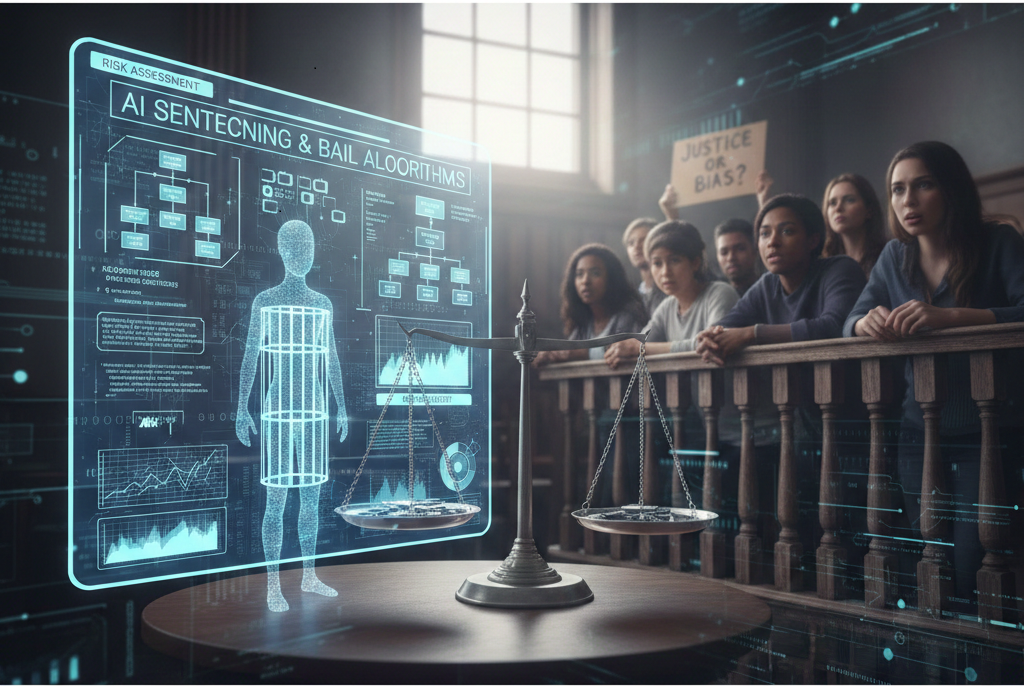
The Ethical Implications of AI-Powered Sentencing and Bail Algorithms
The use of artificial intelligence in the criminal justice system is becoming more widespread in order to provide assistance with the assessment of bail and sentence judgments. These systems are meant to evaluate enormous amounts of data, which may include a person’s criminal history, demographic information, and patterns of behavior, in order to come up with a prediction on the possibility of the individual committing another offense or failing to appear in court. It is argued by proponents that artificial intelligence has the potential to reduce human subjectivity, hence making court rulings more uniform, data-driven, and efficient. Automated solutions have the potential of facilitating speedier case processing and more uniform results in judicial systems that are already overburdened. Nevertheless, there are significant ethical considerations that emerge when artificial intelligence is used to judgments that directly impact human liberty. Neither the sentencing nor the bail process are just technical procedures; rather, they are profoundly moral and social opinions. The use of algorithms in various domains gives rise to basic concerns about impartiality, accountability, transparency, and the protection of human rights. In order to maintain both justice and public trust, it is vital to have a solid knowledge of the ethical implications of artificial intelligence as technology becomes more dominant in judicial systems.
Gaining an Understanding of the Workings of Sentencing and Bail Algorithms
The majority of the time, predictive models that are trained on historical data from the criminal justice system are used to drive AI-powered sentencing and bail systems. Some examples of risk scores that may be estimated using these models include the likelihood that a defendant would commit another crime or that they will fail to appear in court. These models evaluate trends in previous instances. When making judgments, members of the judicial system may utilize these risk evaluations as advising tools. The algorithms take into account a wide range of factors, such as age, previous convictions, work status, and other factors, and occasionally even geographic data. In spite of the fact that these characteristics could seem to be neutral, they often indicate larger societal disparities that are intrinsic to historical data. While the artificial intelligence is able to recognize statistical connections, it is not capable of comprehending moral context or specific situations. What this indicates is that the system makes predictions about conduct based on patterns rather than on ethical or legal thinking. Therefore, artificial intelligence acts more like a probability engine than it does like a justice system. This technological constraint is at the heart of many ethical problems that are associated with algorithmic justice that have been raised.
Concerns Regarding Discrimination and Bias in Algorithms
Algorithmic prejudice is one of the most severe ethical problems that we face today. AI systems often absorb existing prejudices that were present in previous judicial processes. This is due to the fact that AI systems learn from historical data. Should earlier sentencing patterns have been impacted by prejudice based on race, economic status, or social status, it is quite probable that the AI will replicate such trends. This may result in particular groups being categorized as greater risk on a constant basis, even when individual circumstances are different. There is a possibility that the algorithm is objective; nonetheless, the outcomes are influenced by biased input data. Consequently, this results in a feedback cycle in which disadvantaged groups continue to be subjected to more severe punishment. Unlike human judges, artificial intelligence systems are unable to consider issues of social justice or moral fairness. Simply put, they are a replication of statistical tendencies. Concerns have been raised over the possibility of prejudice being built into automated legal systems as a result of this. The notion of equal treatment under the law is put in jeopardy when AI sentencing is influenced by bias.
Lack of Explainability and Transparency in the Situation
The lack of openness in the decision-making process undertaken by these algorithms presents yet another significant ethical concern. Numerous artificial intelligence models function as intricate systems that even their creators are unable to completely comprehend. Due to this, there is a “black box” difficulty in the process of making legal decisions. The defendants and their attorneys may not comprehend the rationale behind the assignment of a certain risk score. The ability to contest or appeal judgments made by algorithms is made more difficult when detailed explanations are not provided. The rights to procedural fairness and due process are undermined as a result of this. The idea that judgments ought to be rational and defensible is the foundation upon which legal systems are constructed. Artificial intelligence reduces responsibility if it is unable to explain its rationale using human language. For there to be confidence in the legal system, transparency is very necessary. The legitimacy of legal power is put in jeopardy when it is implemented a system that cannot be questioned or comprehended.
There are gaps in accountability and responsibility.
Complex problems of responsibility are raised by judgments that are enabled by AI. Who is liable for the damage that occurs when an algorithm is responsible for contributing to an unfair sentence outcome? Is it the judge, the people who build software, the companies that give data, or the organization that is utilizing the system? Uncertainty arises in terms of ethics and the law as a result of this distribution of responsibilities. Traditional legal systems are based on human accountability, which means that judges are required to take personal responsibility for the choices they make. When there is artificial intelligence involved, accountability is split up among a number of different players. Because of this, it is difficult to determine who is to blame or to find solutions for mistakes. There is a possibility that victims of algorithmic injustice do not have a specific way to dispute the system. There is a danger of establishing legal murky areas if artificial intelligence is used in judicial systems without defined accountability frameworks. The establishment of clearly defined lines of duty is necessary for ethical governance. In the absence of them, justice becomes disjointed and devoid of individuality.
Repercussions for the Discretion of the Judiciary and Human Judgement
By molding the way judges see defendants, artificial intelligence technologies have the potential to quietly affect court conduct. There is a possibility that risk scores could result in cognitive bias, which will cause judges to rely more strongly on algorithmic evaluations than on their own personal evaluations. Because of this, judicial discretion and critical thinking may become less effective over time. Based on the assumption that AI suggestions are more objective or accurate, judges may choose to defer to them. This weakens the human aspect of justice, which includes empathy, moral reasoning, and an awareness of the environment in which justice is being administered. When it comes to making choices in the legal system, statistical prediction is not enough; ethical judgment is also required. Artificial intelligence is incapable of comprehending personal repentance, regret, or societal context. When judges place an excessive amount of reliance on algorithms, the legal system becomes completely mechanized. There is a possibility that this may result in justice being more of a technological procedure than a moral one. One of the most important ethical concerns is the deterioration of human judgment.
Issues Regarding Privacy and the Protection of Data
The algorithms that determine sentences and bail are dependent on vast volumes of personal data. Criminal histories, career histories, family histories, and even psychiatric evaluations from time to time are all included in this category. Because of the sensitive nature of the data being collected and processed, there are significant privacy issues. People may be unaware of the data that is being utilized or the analysis that is being performed on it. In addition, there is the possibility of data breaches or improper usage. In the event that illegal access is gained, sensitive legal data that is housed in algorithmic systems becomes a lucrative target. In addition, information that is either false or out of date may be used to draw judgments about persons. Both the criteria of data accuracy and consent are violated by this action. Strong data protection protocols are required for the ethical use of artificial intelligence. It is possible that algorithmic justice systems might violate basic privacy rights if they do not have them.
Defendants are subject to social and psychological repercussions.
Defendants face psychological and societal repercussions as a result of the employment of artificial intelligence in sentencing and bail administration. An person may experience feelings of dehumanization and powerlessness when they are judged by an algorithm. A decrease in faith in legal institutions may occur as a result of defendants’ perceptions of the system as being impersonal and prejudiced. It is possible for this to result in emotions of alienation and unfairness, even in situations when the consequences are legally supported. When people get the impression that they are being assessed by a computer, it may be detrimental to the legitimacy of the judicial process. Justice is not just about the results, but also about how a situation is considered to be fair. The erosion of social trust occurs when individuals have the perception that choices are made by processes that are not transparent. The public’s faith in the rule of law may be negatively impacted as a result of this in the long run. Rather than focusing only on efficiency, ethical justice systems should also take into account emotional and psychological factors.
Concerning the Importance of Ethical Governance and Regulation
Establishing robust governance structures is very necessary in order to solve these ethical concerns. Artificial intelligence (AI) technologies that are employed in the criminal justice system need to be clear, auditable, and subject to independent review. Both the ways in which algorithms may be used and the ways in which their results can be understood must to be governed by clear legal norms. The power to make final decisions must be retained by human judges, and they should be taught to critically analyze proposals made by artificial intelligence. Evaluations of prejudice should be carried out on a regular basis in order to identify and rectify discriminatory trends. It is important that defendants have the ability to contest the results of algorithmic evaluations. When it comes to ethical regulation, human rights, justice, and responsibility should take precedence above efficiency goals. The purpose of artificial intelligence should be to serve justice, not to replace it. The use of artificial intelligence in sentencing and bail runs the danger of eroding the basic underpinnings of legal justice if it is not governed by rigorous ethical principles.