AI vs Manual Sorting in Municipal Recycling Operations: Cost and Accuracy Breakdown
AI vs Manual Sorting in Municipal Recycling Operations: Cost and Accuracy Breakdown
The sorting of recyclable materials in an effective manner continues to be a continuous difficulty, despite the fact that municipal recycling operations play an essential role in waste management. For the purpose of sorting items including plastics, metals, paper, and glass, traditional manual sorting processes rely on human laborers. It is labor-intensive, slower, and prone to irregularities, despite the fact that this approach has been quite popular for decades. In response to rising garbage quantities and more stringent environmental regulations, municipalities are investigating methods that are more technologically sophisticated. Through the use of machine vision and robotics, artificial intelligence is now being implemented in order to automate sorting procedures. These artificial intelligence systems are able to recognize and differentiate between materials with a great degree of speed and accuracy. The comparison of AI-driven sorting versus manual approaches is becoming an important issue for those who are responsible for making decisions. This review places a significant emphasis on cost efficiency, accuracy, and scalability as essential elements. For the purpose of improving recycling processes, it is vital to have a solid understanding of the distinctions between these techniques.
Comprehending the Procedures Involved in Manual Sorting
For the purpose of manual sorting, staff are stationed along conveyor belts and are responsible for visually identifying and separating recyclable items. The human capacity for judgment, concentration, and physical endurance are all essential components of this process. Workers have to be able to differentiate between various materials in a short amount of time, which may be difficult when the materials are comparable in appearance or polluted. Over time, fatigue and jobs that are repeated may lead to a reduction in accuracy, which can result in mistakes in sorting. In addition, personnel who do manual sorting are put in danger by a variety of hazards, such as sharp items and dangerous garbage. In spite of these restrictions, manual systems are generally inexpensive to set up and may be as versatile as possible when it comes to managing things that are unforeseen. Due to the simple nature of this strategy, many smaller institutions continue to depend on it. In spite of this, the limits of manual sorting become increasingly evident as waste streams get more complicated. With regard to these activities, the most important issues are efficiency and consistency.
How Artificial Intelligence Sorting Systems Operate
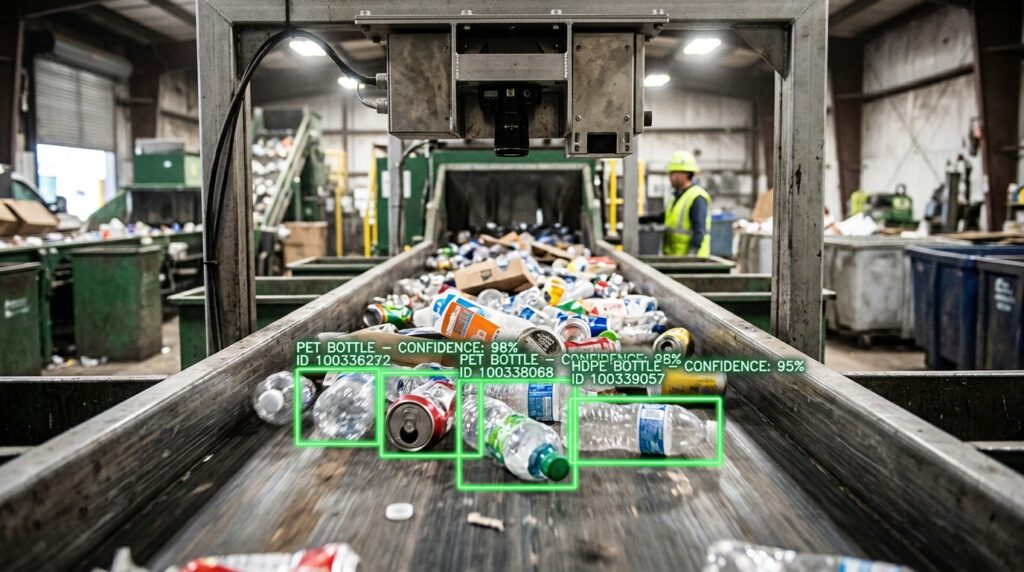
In order to recognize and separate recyclable items, artificial intelligence sorting systems make use of machine learning, computer vision, and robotic mechanics. Detailed pictures and data are captured by cameras and sensors that scan goods that are being transported on conveyor belts. An artificial intelligence model performs an analysis on this data in order to categorize materials according to their shape, color, texture, and composition. After the objects have been recognized, they are separated into the appropriate categories by means of either robotic arms or air jets. These machines are able to process materials at high rates without experiencing fatigue, so ensuring that their performance remains constant throughout the operation. Large datasets are used to train artificial intelligence models, which enables these algorithms to properly detect a broad variety of materials. Over the course of time, they are able to enhance their performance by gaining knowledge from fresh data. The use of this automated technique decreases the amount of manual work that is required and boosts the efficiency of the process. Artificial intelligence systems are a huge step forward in the field of recycling technologies.
Comparing the Accuracy of Manual Methods versus Artificial Intelligence
When it comes to recycling processes, accuracy is of the utmost importance since improper sorting may contaminate whole batches of recyclable materials. Depending on the worker’s level of expertise, experience, and the working environment, the accuracy of manual sorting might vary. Inconsistencies are particularly prevalent during lengthy shifts, despite the fact that experienced workers are capable of achieving a decent level of accuracy. On the other hand, artificial intelligence systems provide findings that are reliable and dependable. They are capable of identifying minute distinctions between materials that may not be discernible to the naked sight of a human being. Consequently, this results in better levels of purity in the materials that have been sorted, which is necessary for efficient recycling. Furthermore, artificial intelligence technologies lessen the possibility of human errors brought on by exhaustion or preoccupation. On the other hand, their precision is contingent upon the calibrating of the system and the quality of the training data. When compared to hand sorting, artificial intelligence often performs better in terms of accuracy and consistency.
Comparing the Initial Investment to the Long-Term Savings in Cost Analysis
In the comparison of AI and manual sorting systems, cost is a significant factor to take into account. The initial investment required for manual sorting is considered to be smaller since it largely comprises manpower and fundamental infrastructure. Ongoing labor expenditures, on the other hand, may be a considerable challenge, particularly in large-scale enterprise operations. When it comes to equipment, installation, and integration, artificial intelligence systems demand a greater initial expenditure. In spite of this, they provide long-term cost benefits resulting from decreased labor expenditures and enhanced efficiency. There are extra expenses associated with AI systems, such as maintenance and system upgrades; however, these costs are often compensated for by operational advantages. Compared to manual approaches, the total cost of ownership for AI systems may be cheaper over the course of their lifetime. Municipalities are required to do an analysis of both the short-term and the long-term financial implications. When it comes to picking the technique that is most appropriate, cost efficiency is a crucial aspect.
Concerns Regarding the Workforce and the Impact on Labor
There are substantial repercussions for the workforce that will result from the use of AI in recycling operations. The manual sorting process is highly dependent on human labor, which not only creates job possibilities but also involves duties that are physically demanding and repetitious throughout the process. The use of artificial intelligence and automation lessens the demand for physical labor, which might result in the displacement of workers. However, it also results in the creation of new positions in the areas of data analysis, system maintenance, and management. Retraining of workers could be necessary in order for them to adjust to these increased obligations. As a result of AI’s ability to decrease exposure to dangerous compounds, another advantage is that it may improve working conditions. The social and economic effects of automation are something that municipalities need to take into consideration. A crucial factor to take into account is the maintenance of a sustainable workforce while maintaining efficiency. Strategies for transitioning may be of assistance in ensuring a seamless transition toward AI-driven operations.
Efficiency in operations and scalability of operations
The capacity of AI sorting systems to scale up is a significant benefit. Artificial intelligence systems are able to manage increasing throughput without requiring a corresponding increase in manpower when trash levels grow. As a result, they are suited for use in major municipal facilities that are experiencing increasing demand. On the other hand, manual sorting necessitates the addition of personnel in order to expand operations, which may lead to a rise in both costs and complexity. AI systems are able to function constantly with very little downtime, which results in an increase in total efficiency. Additionally, they enables quicker processing rates, which in turn reduces bottlenecks in the workflow of the recycling process. Scalability is an essential component for government entities who have the objective of increasing their capacity for recycling. Artificial intelligence offers a solution that is more flexible in dealing with expanding waste streams. The use of automation results in a considerable improvement in operational efficiency.
The Impact on the Environment and the Quality of Recycling
There is a clear correlation between the efficiency of recycling operations and the sustainability of the environment. An increase in the precision of the sorting process results in recycled materials of higher quality, which may for more efficient reuse. By lowering the percentage of contamination, artificial intelligence technologies help to increase the quality of recycling. This contributes to the development of a circular economy while also increasing the value of recycled resources. There is a possibility that manual sorting could result in increased contamination, which would reduce the efficiency of recycling activities. AI also makes it possible to separate materials with greater precision, particularly those that are complicated or jumbled together. As a result, total recovery rates are improved, and trash from landfills is decreased. The advantages that improved sorting technologies provide to the environment are a primary motivator for their use. Using AI, recycling procedures may become more environmentally friendly and effective.
The Emerging Trends in the Automation of Recycling
Increasingly, developments in artificial intelligence and automation are having a significant impact on the future of municipal recycling. There is a high probability that new technologies will improve the capabilities of artificial intelligence sorting systems, making them more precise and adaptable. The integration of recycling operations with intelligent waste management systems may make it possible to monitor and optimize recycling procedures in real time. It may be possible for AI models to become more adaptable, allowing them to handle a greater range of materials with minimum reinforcing. On the other hand, robotics may grow more sophisticated, which would improve the speed and accuracy of sorting. The use of artificial intelligence systems is projected to increase across governments of all sizes as the prices of technology continue to reduce. Waste management is undergoing a tremendous upheaval as a result of the trend toward automation. Municipalities that make investments in solutions powered by artificial intelligence will be in a better position to face future problems in the areas of environmental and operational management.